

Suggestions
Idioma
Guide for authors
Searcher
Journal Information
Vol. 225. Issue 10.
(December 2025)
Cite
Cite
Share
Download PDF
More article options
Visits
927
Vol. 225. Issue 10.
(December 2025)
Original article

Epidemiology of rhinovirus/enterovirus infection in hospitalized patients

Epidemiología de la infección por rinovirus/enterovirus en pacientes hospitalizados
Visits
927
B. Lopez-Villalbaa,
Corresponding author
blancalopezvillalba@gmail.com

Corresponding author.
, L. Tejedor-Canterob, M. Toquero-Asensioc,d, V. Fernández-Espinillaa, C. Hernán-Garcíaa, S. Rojo-Rellob, C. Prada-Garcíac,e,f, J.M. Eiros-Bouzac,g, J. Castrodeza-Sanza,c,e
a Preventive Medicine and Public Health Unit, Hospital Clínico Universitario de Valladolid, Valladolid, Spain
b Microbiology Unit, Hospital Clínico Universitario de Valladolid, Valladolid, Spain
c National Influenza Centre, Edificio Rondilla, Hospital Clínico Universitario de Valladolid, 47009 Valladolid, Spain
d Fundación Instituto de Estudios de Ciencias de la Salud de Castilla y León (ICSCYL), Valladolid, Spain
e Department of Preventive Medicine and Public Health, University of Valladolid, 47005 Valladolid, Spain
f Dermatology Service, Complejo Asistencial Universitario de León, 24008 León, Spain
g Microbiology Unit, Hospital Universitario Río Hortega, Valladolid, Spain
This item has received
Article information
Abstract
Full Text
Bibliography
Download PDF
Statistics
Abstract
Background and Objective

Rhinovirus/enterovirus (RV/EV), commonly known for causing mild colds, has emerged as a significant cause of hospitalization. The objective of the study is to analyze the characteristics of patients hospitalized for viral respiratory infections, with an emphasis on RV/EV.

Methodology

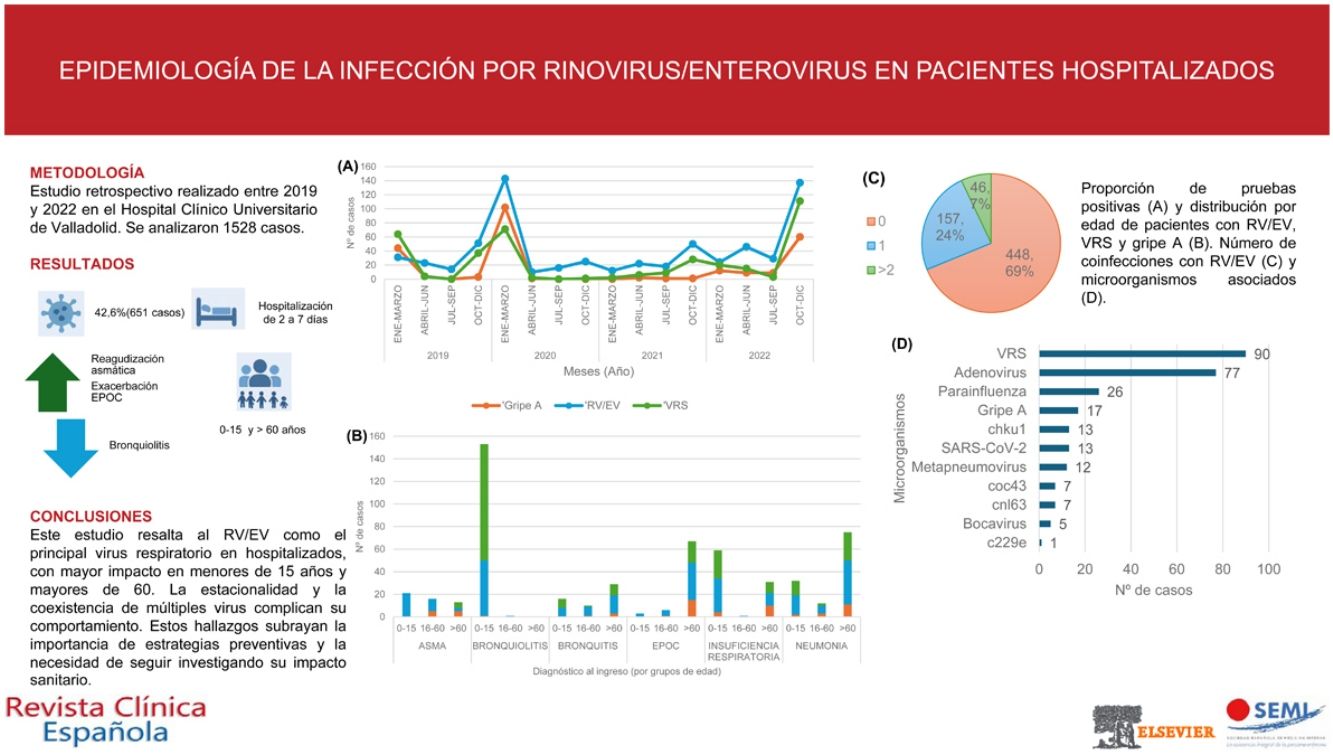
This retrospective study was conducted between 2019 and 2022 at the University Clinical Hospital of Valladolid. Data from 1,528 cases were analyzed, sourced from medical records and microbiological tests (Biofire Respiratory y NxTAG respiratory panel).

Results

RV/EV was the most common respiratory virus (42.6%). There was a slight predominance of cases in males. 44.6% had a hospital stay of 2–7 days. The average hospitalization incidence was 3 per 1,000 adults per year. Children aged 0–15 years are at higher risk of RV/EV infection, with a 1.5 times higher probability in single infections (OR 1.496; 95% CI 1.147−1.952; p = 0.003), 7 times in coinfections with other respiratory viruses (OR 6.887; 95% CI 3.928–12.045; p < 0.01), and 8 times in coinfections with RSV (OR 8.580; 95% CI 3.866−19.041; p < 0.01). RV/EV is associated with a higher risk of asthma exacerbation (OR 2.545; 95% CI 1.336−4.851; p = 0.005) and COPD exacerbation (OR 1.781; 95% CI 1.022−3.103; p = 0.042), but a lower probability of bronchiolitis (OR 0.236; 95% CI 0.117−0.474; p < 0.01).

Conclusion

This study identifies RV/EV as the main respiratory virus in hospitalized patients, with a greater impact on those under 15 years and over 60 years. Seasonality and the coexistence of multiple viruses complicate its behaviour. These findings underscore the importance of preventive strategies and the need for continued research on its health impact.

Keywords:
Rhinovirus
Hospitalization
Preventive strategies
Abbreviations:
COPD
HEV
OR
HRV
RV/EV
RSV
Resumen
Antecedentes y objetivo

El rinovirus/enterovirus (RV/EV), conocido comúnmente por causar resfriados leves, ha emergido como una causa significativa de hospitalización. El objetivo del estudio es analizar las características de los pacientes hospitalizados por infecciones respiratorias virales, con énfasis en RV/EV.

Metodología

Este estudio retrospectivo, realizado entre 2019 y 2022 en el Hospital Clínico Universitario de Valladolid. Se analizaron datos de 1.528 casos, procedentes de historias clínicas y pruebas microbiológicas (Biofire Respiratory y NxTAG respiratory panel).

Resultados

El RV/EV fue el virus respiratorio más común (42,6%). Leve predominio de casos en hombres. Un 44,6% presentaron una estancia hospitalaria de 2 a 7 días. La incidencia media de hospitalización fue 3/1000 adultos/año. Los niños de 0 a 15 años presentan mayor riesgo de infección por RV/EV, con una probabilidad 1,5 veces mayor en infecciones únicas (OR 1,496; IC95% 1,147−1,952; p = 0,003), 7 veces en coinfecciones con otros virus respiratorios (OR 6,887; IC95% 3,928−12,045; p < 0,01) y 8 veces en coinfecciones con VRS (OR 8,580; IC95% 3,866−19,041; p < 0,01). El RV/EV se asocia con mayor riesgo de reagudización asmática (OR 2,545; IC95% 1,336−4,851; p = 0,005) y exacerbación de EPOC (OR 1,781; IC95% 1,022−3,103; p = 0,042), pero menor probabilidad de bronquiolitis (OR 0,236; IC95% 0,117−0,474; p < 0,01).

Conclusión

Este estudio resalta al RV/EV como el principal virus respiratorio en hospitalizados, con mayor impacto en menores de 15 años y mayores de 60. La estacionalidad y la coexistencia de múltiples virus complican su comportamiento. Estos hallazgos subrayan la importancia de estrategias preventivas y la necesidad de seguir investigando su impacto sanitario.
Palabras clave:
Rinovirus
Hospitalización
Estrategias preventivas
Graphical abstract

Article

These are the options to access the full texts of the publication Revista Clínica Española (English Edition)
Member
Si es usted socio de FESEMI siga los siguientes pasos:

Diríjase desde aquí a la web de la >>>https://www.fesemi.org/publicaciones/revista-clinica/noticias<<< e inicie sesión mediante el formulario que se encuentra en la barra superior, pulsando sobre el candado.

Deslice el cursor hacia abajo hasta la sección "PUBLICACIONES" y pinche en "Revista Clínica Española":

>>>https://www.fesemi.org/publicaciones/revista-clinica/noticias<<<


Subscriber
Subscriber

If you already have your login data, please click here .

If you have forgotten your password you can you can recover it by clicking here and selecting the option “I have forgotten my password”
Subscribe
Subscribe to
Revista Clínica Española (English Edition)
Purchase
Purchase article

Purchasing article the PDF version will be downloaded

Purchase now
Contact
Phone for subscriptions and reporting of errors
From Monday to Friday from 9 a.m. to 6 p.m. (GMT + 1) except for the months of July and August which will be from 9 a.m. to 3 p.m.
Calls from Spain
932 415 960
Calls from outside Spain
+34 932 415 960
Email
References
[1]
Novedades en el tratamiento de la bronquiolitis: perspectivas en el 2013 - ClinicalKey [Internet]. [citado 4 de septiembre de 2023]. Available from: https://www.clinicalkey.es/#!/content/playContent/1-s2.0-S1695403313000891?returnurl=https:%2F%2Flinkinghub.elsevier.com%2Fretrieve%2Fpii%2FS1695403313000891%3Fshowall%3Dtrue&referrer=.
[2]
K. Dumaidi, A. Al-Jawabreh, F. Samarah, A. Zraiqi, D. Yaseen.
Genetic diversity of the enteroviruses detected from cerebrospinal fluid (CSF) samples of patients with suspected aseptic meningitis in northern West Bank, Palestine in 2017.
PLoS ONE., 13 (2018),
[3]
T. Jartti, J.E. Gern.
Rhinovirus-associated wheeze during infancy and asthma development.
Curr Respir Med Rev., 7 (2011), pp. 160-166
[4]
T. Jartti, W.M. Lee, T. Pappas, M. Evans, R.F. Lemanske, J.E. Gern.
Serial viral infections in infants with recurrent respiratory illnesses.
Eur Respir J., 32 (2008), pp. 314-320
[5]
E.K. Miller, X. Lu, D.D. Erdman, K.A. Poehling, Y. Zhu, M.R. Griffin, et al.
Rhinovirus-associated hospitalizations in young children.
J Infect Dis., 195 (2007), pp. 773-781
[6]
Changes in Seasonal Respiratory Illnesses in the United States During the Coronavirus Disease 2019 (COVID-19) Pandemic | Clinical Infectious Diseases | Oxford Academic [Internet]. [citado 4 de septiembre de 2023]. Disponible en: https://academic.oup.com/cid/article/73/Supplement_1/S110/6257582?login=false.
[7]
Viruses | Free Full-Text | The Positive Rhinovirus/Enterovirus Detection and SARS-CoV-2 Persistence beyond the Acute Infection Phase: An Intra-Household Surveillance Study [Internet]. [citado 4 de septiembre de 2023]. Available from: https://www.mdpi.com/1999-4915/13/8/1598.
[8]
Portal de Salud de la Junta de Castilla y León [Internet]. [citado 28 de mayo de 2025]. Área de influencia. Available from: https://www.saludcastillayleon.es/HCUValladolid/es/area-influencia.
[9]
M.T. Cuevas, M. Molinero, F. Pozo, C. Calvo, M.L. García‐García, N. Reyes, et al.
Spread of different rhinovirus B genotypes in hospitalized children in Spain.
Influenza Other Respir Viruses., 7 (2013), pp. 623-628
[10]
J.P. Mullooly, C.B. Bridges, W.W. Thompson, J. Chen, E. Weintraub, L.A. Jackson, et al.
Influenza- and RSV-associated hospitalizations among adults.
Vaccine., 25 (2007), pp. 846-855
[11]
A. Piralla, F. Rovida, G. Campanini, V. Rognoni, A. Marchi, F. Locatelli, et al.
Clinical severity and molecular typing of human rhinovirus C strains during a fall outbreak affecting hospitalized patients.
J Clin Virol., 45 (2009), pp. 311-317
[12]
E.K. Miller, J. Linder, D. Kraft, M. Johnson, P. Lu, B.R. Saville, et al.
Hospitalizations and Outpatient Visits for Rhinovirus - Associated Acute Respiratory Illness in Adults.
J Allergy Clin Immunol., 137 (2016), pp. 734-743.e1
[13]
J.M. Radin, A.W. Hawksworth, P.E. Kammerer, M. Balansay, R. Raman, S.P. Lindsay, et al.
Epidemiology of Pathogen-Specific Respiratory Infections among Three US Populations.
PLoS One., 9 (2014),
[14]
A. Pierangeli, M. Ciccozzi, S. Chiavelli, C. Concato, M. Giovanetti, E. Cella, et al.
Molecular epidemiology and genetic diversity of human rhinovirus affecting hospitalized children in Rome.
Med Microbiol Immunol (Berl)., 202 (2013), pp. 303-311
[15]
E. Le Glass, V.T. Hoang, C. Boschi, L. Ninove, C. Zandotti, A. Boutin, et al.
Incidence and outcome of coinfections with SARS-CoV-2 and rhinovirus.
Viruses., 13 (2021),
[16]
C. Calvo Rey, M.L. García García, I. Casas Flecha, M.F. Sánchez Mateos, G. Rodrigo García, J.M. de Cea Crespo, et al.
Papel del rinovirus en las infecciones respiratorias en niños hospitalizados.
An Pediatr Barc Spain, 65 (2006), pp. 205-210
[17]
L. Andréoletti, M. Lesay, A. Deschildre, V. Lambert, A. Dewilde, P. Wattré.
Differential detection of rhinoviruses and enteroviruses RNA sequences associated with classical immunofluorescence assay detection of respiratory virus antigens in nasopharyngeal swabs from infants with bronchiolitis.
J Med Virol., 61 (2000), pp. 341-346
[18]
N.B. Achten, P. Wu, L. Bont, M.O. Blanken, T. Gebretsadik, J.D. Chappell, et al.
Interference between respiratory syncytial virus and human rhinovirus infection in infancy.
J Infect Dis., 215 (2017), pp. 1102-1106
[19]
J. Carrillo, V. Villafuerte.
Metapneumovirus, Bocavirus y rinovirus en la patogenia y exacerbación del asma y otras afecciones respiratorias en niños.
Enferm Investiga., 7 (2022), pp. 73
[20]
A. Kotaniemi-Syrjänen, R. Vainionpää, T.M. Reijonen, M. Waris, K. Korhonen, M. Korppi.
Rhinovirus-induced wheezing in infancy--the first sign of childhood asthma?.
J Allergy Clin Immunol., 111 (2003), pp. 66-71
[21]
J.M. Mansbach, R.J. Geller, K. Hasegawa, P.A. Piedra, V. Avadhanula, J.E. Gern, et al.
Detection of respiratory syncytial virus or rhinovirus weeks after hospitalization for bronchiolitis and the risk of recurrent wheezing.
J Infect Dis., 223 (2020), pp. 268-277
[22]
T. Juvén, J. Mertsola, M. Waris, M. Leinonen, O. Meurman, M. Roivainen, et al.
Etiology of community-acquired pneumonia in 254 hospitalized children.
Pediatr Infect Dis J., 19 (2000), pp. 293-298
[23]
G.R. McLean.
Developing a vaccine for human rhinoviruses.
J Vaccines Immun., 2 (2014), pp. 16-20
Idiomas
Revista Clínica Española (English Edition)
Article options
Tools
