
Suggestions
Idioma
Guide for authors
Searcher
Journal Information
Cite
Cite
Share
Download PDF
More article options
Visits
178
Original article
Uncorrected Proof. Available online 29 September 2026

Trends in the structure, activity, and outcomes of Internal Medicine Services in the National Health System (2007–2024): The RECALMIN Study VI

Evolución de la estructura, actividad y resultados de los servicios de Medicina Interna en el Sistema Nacional de Salud (2007–2024): estudio RECALMIN VI
Visits
178
M.M. Chimeno Viñasa, J.M. Porcelb, P. Pérez-Martínezc, J.L. Bianchi Llaved, J. Moreno Díaze, N. del Pradof, F.J. Elola Somozaf,
Corresponding author
fjelola@movistar.es

Corresponding author.
a Presidenta de SEMI. Complejo Asistencial de Zamora
b Vicepresidente Primero de SEMI. Hospital Universitario Arnau de Vilanova de Lleida
c Vicepresidente Segundo SEMI. Hospital Universitario Reina Sofía /IMIBIC/Universidad de Córdoba, Córdoba, Spain
d Tesorero de la SEMI. Hospital Universitario Punta de Europa, Algeciras, Spain
e Secretario de la SEMI. Hospital Nuestra Señora de Gracia, Zaragoza, Spain
f Fundación Instituto para la Mejora de la Asistencia Sanitaria. Cátedra IMAS-Universidad Rey Juan Carlos, Madrid, Spain
This item has received
Article information
Abstract
Full Text
Bibliography
Download PDF
Statistics
Abstract
Objectives

To analyse the evolution of the structure, activity and outcomes of Internal Medicine Departments (IMDs) within the Spanish National Health System (SNHS) between 2007 and 2024, and to assess their alignment with the strategic priorities of the specialty.

Methods

Observational study based on two data sources: (1) the RECALMIN survey on IMD structure and activity, and (2) the Minimum Basic Data Set (CMBD), including more than 9.9 million hospital discharges. Temporal trends were analysed using Poisson regression models and risk-adjusted models for hospital mortality.

Results

Over the study period, a significant increase was observed in the number of internists per population (IRR = 1.04–1.06), as well as in hospital activity and patient complexity. IMDs account for approximately 20% of all hospital discharges within the SNHS. Crude hospital mortality increased, whereas risk-adjusted mortality showed a declining trend until 2015 followed by subsequent stabilisation. The implementation of key organisational models (hospital-at-home programmes, co-management models, and care pathways for complex chronic patients) remains limited.

Conclusions

IMDs have experienced a sustained increase in activity and case complexity over the past two decades, while maintaining overall stable risk-adjusted outcomes. However, a gap persists between the growing care burden and the implementation of organisational models aligned with the strategic direction of the specialty.

Keywords:
Internal Medicine
Internal Medicine Departments
Management
Quality
Efficiency
Outcomes
Resumen
Objetivos

Analizar la estructura, actividad y resultados de los Servicios de Medicina Interna (SMI) del Sistema Nacional de Salud (SNS) entre 2007 y 2024, y evaluar su alineación con las líneas estratégicas de la especialidad.

Material y métodos

Estudio observacional basado en dos fuentes: 1) encuesta RECALMIN sobre estructura y actividad de los SMI, y 2) datos del Conjunto Mínimo Básico de Datos (CMBD), con más de 9,9 millones de altas hospitalarias. Se analizaron tendencias temporales mediante modelos de regresión de Poisson y modelos de ajuste de riesgo para mortalidad hospitalaria.

Resultados

Durante el periodo analizado se observó un incremento significativo en el número de internistas por población (IRR = 1,04–1,06), en la actividad hospitalaria y en la complejidad de los pacientes atendidos. Los SMI generan aproximadamente el 20% de las altas hospitalarias del SNS. La mortalidad hospitalaria bruta aumentó, mientras que la mortalidad ajustada por riesgo mostró una tendencia descendente hasta 2015 y una estabilización posterior. La implantación de modelos organizativos clave (hospitalización a domicilio, asistencia compartida o programas de pacientes complejos) sigue siendo limitada.

Conclusiones

Los SMI han incrementado su actividad y complejidad asistencial en las últimas dos décadas, manteniendo resultados ajustados globalmente estables. Sin embargo, persiste un desfase entre la creciente carga asistencial y la implantación de modelos organizativos alineados con las estrategias de la especialidad.

Palabras clave:
Medicina Interna
Servicios de Medicina Interna
Gestión
Calidad
Eficiencia
RECALMIN

Article

These are the options to access the full texts of the publication Revista Clínica Española (English Edition)
Member
Si es usted socio de FESEMI siga los siguientes pasos:

Diríjase desde aquí a la web de la >>>https://www.fesemi.org/publicaciones/revista-clinica/noticias<<< e inicie sesión mediante el formulario que se encuentra en la barra superior, pulsando sobre el candado.
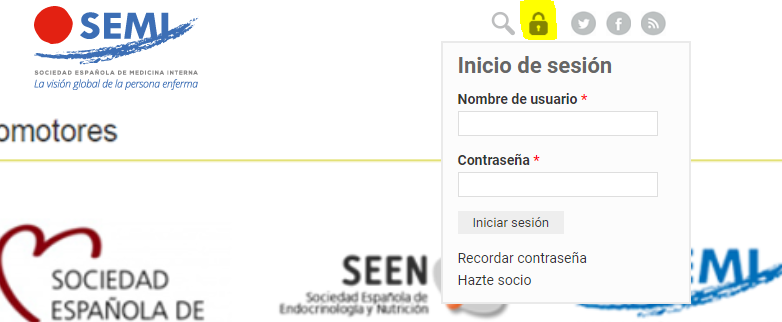
Deslice el cursor hacia abajo hasta la sección "PUBLICACIONES" y pinche en "Revista Clínica Española":

>>>https://www.fesemi.org/publicaciones/revista-clinica/noticias<<<


Subscriber
Subscriber

If you already have your login data, please click here .

If you have forgotten your password you can you can recover it by clicking here and selecting the option “I have forgotten my password”
Subscribe
Subscribe to
Revista Clínica Española (English Edition)
Purchase
Purchase article

Purchasing article the PDF version will be downloaded

Purchase now
Contact
Phone for subscriptions and reporting of errors
From Monday to Friday from 9 a.m. to 6 p.m. (GMT + 1) except for the months of July and August which will be from 9 a.m. to 3 p.m.
Calls from Spain
932 415 960
Calls from outside Spain
+34 932 415 960
Email
References
[1]
J.E. Losa, A. Zapatero, R. Barba, J. Marco, S. Plaza, J. Canora.
Encuesta SEMI sobre la oferta asistencial de los internistas en los hospitales del Sistema Público de Salud.
Rev Clin Esp, 211 (2011), pp. 223-232
[2]
A. Zapatero Gaviria, R. Barba Martín, P. Román Sánchez, et al.
RECALMIN. La atención al paciente en las unidades de Medicina Interna del Sistema Nacional de Salud.
Rev Clin Esp, 216 (2016), pp. 175-182
[3]
A. Zapatero-Gaviria, R. Barba-Martín, J. Canora Lebrato, et al.
RECALMIN II. Ocho años de hospitalización en las Unidades de Medicina Interna (2007-2014). ¿Qué ha cambiado?.
Rev Clin Esp, 217 (2017), pp. 446-453
[4]
J. Díez-Manglano, J. Carretero-Gómez, M.M. Chimeno-Viñas, et al.
RECALMIN IV. Evolution in the activity of internal medicine units of the National Health System (2008-2021).
Rev Clin Esp (Barc), 223 (2023), pp. 125-133
[5]
J. Carretero Gómez, M.M. Chimeno Viñas, J.M. Porcel Pérez.
RECALMIN V. Evolución de la actividad de las unidades de medicina interna del Sistema Nacional de Salud (2007-2022).
Rev Clin Esp (Barc), 225 (2025), pp. 211-222
[6]
E. Casariego-Vales, A. Zapatero-Gaviría, F.J. Elola-Somoza.
La Medicina Interna del Siglo XXI : Estándares de Organización y Funcionamiento.
Rev Clin Esp, 217 (2017), pp. 526-533
[7]
J. Varela, A. Zapatero, R. Gómez-Huelgas, A. Maestre, J. Díez-Manglano, R. Barba.
Por una Medicina Interna de alto valor.
Sociedad Española de Medicina Interna, (2019),
[8]
R. Gómez Huelgas, J. Díez Manglano, J. Carretero Gómez, et al.
El hospital del futuro en 10 puntos.
Rev Clin Esp, 220 (2020), pp. 444-449
[9]
J. García-Alegría, P. Conthe-Gutiérrez.
Orientación estratégica de la Sociedad Española de Medicina Interna.
Rev Clin Esp, 211 (2011), pp. 46-51
[10]
J. Carretero Gómez, M.M. Chimeno Viñas, J.M. Porcel Pérez, et al.
en nombre de los miembros de los comités para el proceso de reflexión estratégica de la SEMI. Resumen ejecutivo de la reflexión estratégica de la Sociedad Española de Medicina Interna 2025-2029 para garantizar la asistencia integral a la persona enferma en un Sistema Nacional de Salud de alto valor.
Rev Clin Esp (Barc), 224 (2024), pp. 609-622
[11]
Sociedad Española de Medicina Interna.
Informe RECALMIN 2025, SEMI, (2026),
[12]
2023 Condition-Specific Measures Updates and Specifications Report Hospital-Level 30-Day Risk-Standardized Mortality Measures. Acute Myocardial Infarction – Version 17.0. Chronic Obstructive Pulmonary Disease – Version 12.0. Heart Failure – Version 17.0. Pneumonia – Version 17.0. Stroke – Version 120.0. Submitted By: Yale New Haven Health Services Corporation/Center for Outcomes Research & Evaluation (YNHHSC/CORE). Prepared For: Centers for Medicare & Medicaid Services (CMS). 2023.
[13]
H. Goldstein, D.J. Spiegelhalter.
League tables and their limitations: statistical aspects of institutional performance.
J Royal Stat Soc, 159 (1996), pp. 385-443
[14]
M. Cranston, C. Semple, R. Duckitt, et al.
The practice of internal medicine in Europe: organisation, clinical conditions and procedures.
Eur J Intern Med, 24 (2013), pp. 627-632
[15]
M. Shaw, A.M. Pelecanos, A.M. Mudge.
Evaluation of internal medicine physician or multidisciplinary team comanagement of surgical patients and clinical outcomes: a systematic review and meta-analysis.
[16]
K. Edgar, S. Iliffe, H.A. Doll, et al.
Admission avoidance hospital at home.
Cochrane Database Syst Rev, 3 (2024),
[17]
O. Bestsennyy, M. Chmielewski, A. Koffel, A. Shah.
From facility to home: How healthcare could shift by 2025.
McKinsey & Company, (2022),
[18]
B. Leff, A. Siu, L.V. DeCherrie, D.M. Levine.
Hospital at Home and Transforming US Health Care Delivery.
JAMA, 335 (2026), pp. 1747-1748
[19]
F.J. Suárez-Dono, C. Martínez-Rey, J. Novo-Platas, et al.
E-consulta entre Atención Primaria y Medicina Interna: implementación, accesibilidad, beneficios e implicaciones.
Rev Clín Esp, 224 (2024), pp. 421-427
[20]
S. Cinza Sanjurjo, P. Mazón Ramos, D. Iglesias Álvarez, D. Rey Aldana, M. Portela Romero, J.R. González-Juanatey.
Consulta electrónica (e-consulta) para pacientes con insuficiencia cardiaca. Resultados a largo plazo.
Rev Esp Cardiol, 75 (2022), pp. 93-95
Idiomas
Revista Clínica Española (English Edition)
Article options
Tools
Supplemental materials
