
Suggestions
Idioma
Guide for authors
Searcher
Journal Information
Vol. 226. Issue 8.
(October 2026)
Cite
Cite
Share
Download PDF
More article options
Visits
577
Vol. 226. Issue 8.
(October 2026)
Review

Training in internal medicine in the age of artificial intelligence

La formación en medicina interna en la era de la inteligencia artificial
Visits
577
J. García-Alegríaa,b,
Corresponding author
jg.alegria@hotmail.com

Corresponding author.
, D. Ruiz-Hidalgoc,d, M. Rodríguez-Carballeirae
a Red de Investigación en Cronicidad, Atención Primaria y Promoción de la Salud (RICAPPS), Marbella, Málaga, Spain
b Instituto de Investigación Biomédica de Málaga y Plataforma en Nanomedicina (IBIMA Plataforma BIONAND), Marbella, Málaga, Spain
c Hospital Universitario Sant Joan de Déu (Althaia), Manresa, Barcelona, Spain
d Facultad de Medicina, Universitat de Vic - Universitat Central de Catalunya (UVIC-UCC), Vic, Barcelona, Spain
e Grup Recerca en Simulació Clínica i Educació Sanitària (SimCES), Vall d’Hebron Institut de Recerca (VHIR), Vall d’Hebron Hospital Universitari, Barcelona, Spain
This item has received
Article information
Abstract
Full Text
Bibliography
Download PDF
Statistics
Abstract

Artificial intelligence (AI) is transforming knowledge management in medicine, with a radical impact on training and the acquisition of professional skills. This review aims to guide and optimise the use of AI in the training of internal medicine residents, with an emphasis on the reliability of information, clinical safety, ethical considerations, the clinical process, prompt engineering, the role of simulation, training risks, shared decision-making with patients, the role of tutors, and opportunities for the speciality, all with the central premise that AI complements but does not replace clinical training.

Keywords:
Artificial intelligence
Internal medicine
Internship and residency
Clinical Competence
Simulation training
Mentoring
Resumen

La inteligencia artificial (IA) está transformando la gestión del conocimiento en Medicina con un impacto radical en la formación y adquisición de competencias profesionales. Esta revisión pretende orientar y optimizar el uso de la IA en la formación de residentes de Medicina Interna con énfasis en la fiabilidad de la información, la seguridad clínica, los aspectos éticos, el proceso clínico, la formulación de preguntas, el papel de la simulación, los riesgos formativos, las decisiones compartidas con el paciente, el rol de los tutores y las oportunidades para la especialidad, todo con la idea central de que la IA complementa aunque no sustituye la formación clínica.
Palabras clave:
Inteligencia artificial
Medicina Interna
Formación de residentes
Competencias profesionales
Simulación clínica
Tutoría clínica
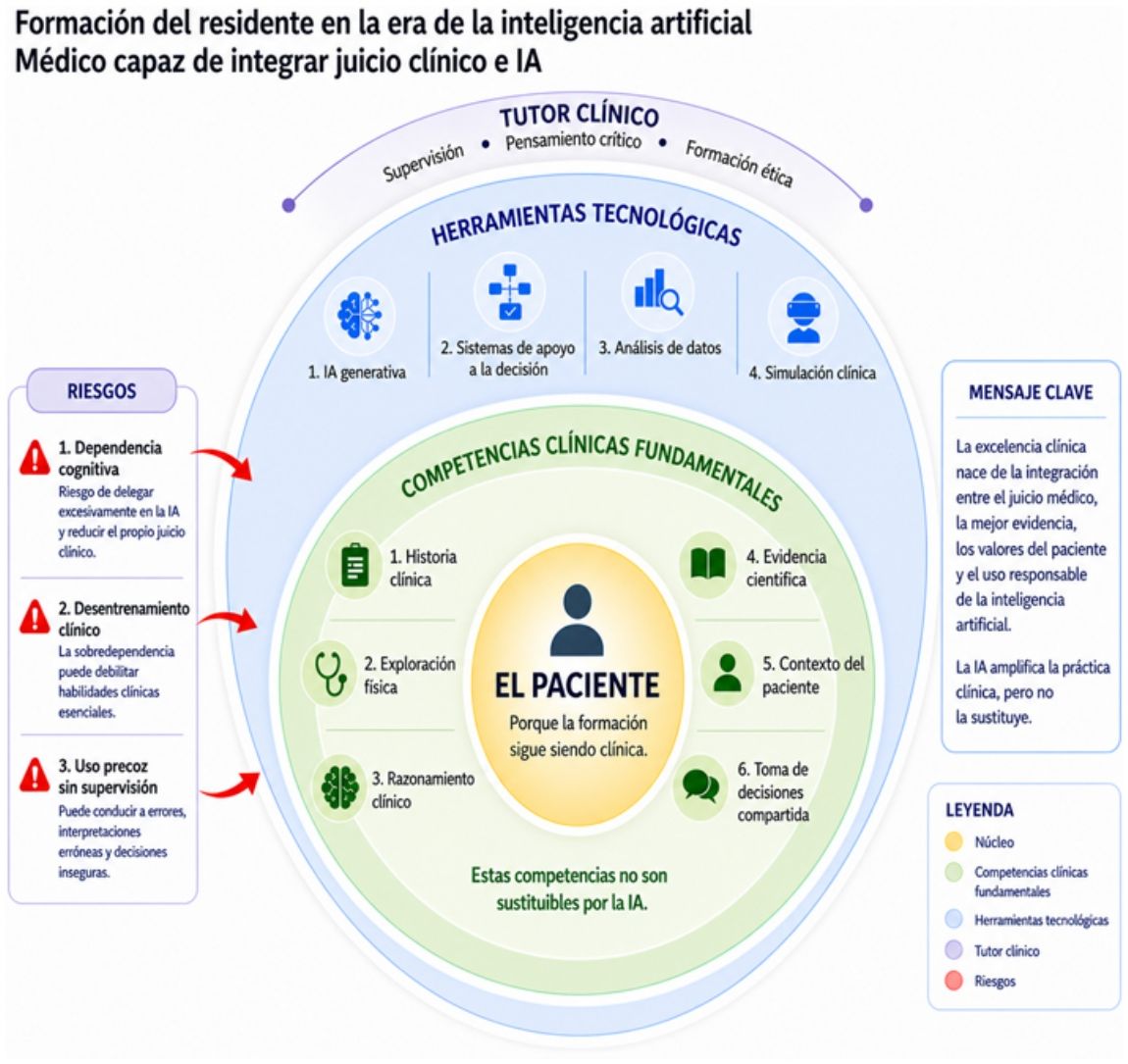
Graphical abstract

Article

These are the options to access the full texts of the publication Revista Clínica Española (English Edition)
Member
Si es usted socio de FESEMI siga los siguientes pasos:

Diríjase desde aquí a la web de la >>>https://www.fesemi.org/publicaciones/revista-clinica/noticias<<< e inicie sesión mediante el formulario que se encuentra en la barra superior, pulsando sobre el candado.

Deslice el cursor hacia abajo hasta la sección "PUBLICACIONES" y pinche en "Revista Clínica Española":

>>>https://www.fesemi.org/publicaciones/revista-clinica/noticias<<<


Subscriber
Subscriber

If you already have your login data, please click here .

If you have forgotten your password you can you can recover it by clicking here and selecting the option “I have forgotten my password”
Subscribe
Subscribe to
Revista Clínica Española (English Edition)
Purchase
Purchase article

Purchasing article the PDF version will be downloaded

Purchase now
Contact
Phone for subscriptions and reporting of errors
From Monday to Friday from 9 a.m. to 6 p.m. (GMT + 1) except for the months of July and August which will be from 9 a.m. to 3 p.m.
Calls from Spain
932 415 960
Calls from outside Spain
+34 932 415 960
Email
References
[1]
D. Cooper, E.S. Holmboe.
Competency-based medical education at the front lines of patient care.
N Engl J Med, 393 (2025), pp. 376-388
[2]
L.D. Howley, A.J. Whelan.
From the world wide web to AI: why we must learn from our past to transform the future of medical education.
Acad Med, 100 (2025), pp. S30-S33
[3]
C.K. Boscardin, R.E. Abdulnour, B.C. Gin.
Macy foundation innovation report part i: current landscape of artificial intelligence in medical education.
Acad Med, 100 (2025), pp. S22-S29
[4]
B.C. Gin, K. LaForge, J. Burk-Rafel, C.K. Boscardin.
Macy foundation innovation report part II: from hype to reality: innovators’ visions for navigating AI integration challenges in medical education.
Acad Med, 100 (2025), pp. S22-S29
[5]
Z. Ahsan.
Integrating artificial intelligence into medical education: a narrative systematic review of current applications, challenges, and future directions.
BMC Med Educ, 25 (2025), pp. 1187
[6]
J. García Alegría, C. García Tortosa, M.D. Martín Escalante, F. Miralles Linares, R. Puchades-Rincón de Arellano, M.M. Chimeno-Viñas.
Artificial intelligence in internal medicine: knowledge, clinical use, and training needs.
Rev Clin Esp (Barc), 226 (2026),
[7]
L. Cortés-Fraile, D. Suescun-Elizalde, J. García-Estañ López.
Use and perception of artificial intelligence among Spanish medical students.
Rev Esp Educ Med, 7 (2026),
[8]
J.L. Bowen.
Educational strategies to promote clinical diagnostic reasoning.
N Engl J Med, 355 (2006), pp. 2217-2225
[9]
J.B. Richards, M.M. Hayes, R.M. Schwartzstein.
Teaching clinical reasoning and critical thinking: from cognitive theory to practical application.
Chest, 158 (2020), pp. 1617-1628
[10]
J. Deng, A. Zubair, Y.J. Park, E. Affan, Q.K. Zuo.
The use of large language models in medicine: proceeding with caution.
Curr Med Res Opin, 40 (2024), pp. 151-153
[11]
L. Wang, Z. Wan, C. Ni, et al.
Applications and concerns of ChatGPT and other conversational large language models in health care: a systematic review.
J Med Internet Res, 26 (2024),
[12]
H. Xu, Y. Wang, Y. Xun, R. Shao, Y. Jiao.
Artificial intelligence for clinical reasoning: the reliability challenge and path to evidence-based practice.
QJM, 118 (2025), pp. 802-804
[13]
J.Y. Yau, S. Saadat, E. Hsu, et al.
Accuracy of prospective assessments of 4 large language model chatbot responses to patient questions about emergency care: experimental comparative study.
J Med Internet Res, 26 (2024),
[14]
N.B. Tiller, A.R. Marcon, M. Zenone, et al.
Generative artificial intelligence-driven chatbots and medical misinformation: an accuracy, referencing, and readability audit.
[15]
M.W. Shiferaw, T. Zheng, A. Winter, L.A. Mike, L.N. Chan.
Assessing the accuracy and quality of artificial intelligence (AI) chatbot-generated responses in making patient-specific drug-therapy and healthcare-related decisions.
BMC Med Inform Decis Mak, 24 (2024), pp. 404
[16]
T.T. Brunyé, S.R. Mitroff, J.G. Elmore.
Artificial intelligence and computer-aided diagnosis in diagnostic decisions: 5 questions for medical informatics and human-computer interface research.
J Am Med Inform Assoc, 33 (2026), pp. 543-550
[17]
R.E. Abdulnour, B. Gin, C.K. Boscardin.
Educational strategies for clinical supervision of artificial intelligence use.
N Engl J Med, 393 (2025), pp. 786-797
[18]
K. Budzyń, M. Romańczyk, D. Kitala, et al.
Risk of endoscopist deskilling following exposure to artificial intelligence in colonoscopy: a multicenter, observational study.
Lancet Gastroenterol Hepatol, 10 (2025), pp. 896-903
[19]
I. Habli, T. Lawton, Z. Porter.
Artificial intelligence in health care: accountability and safety.
Bull World Health Organ, 98 (2020), pp. 251-256
[20]
A. Čartolovni, A. Tomičić, E. Lazić Mosler.
Ethical, legal, and social considerations of AI-based medical decision-support tools: a scoping review.
[21]
S. Labkoff, B. Oladimeji, J. Kannry, et al.
Toward a responsible future: recommendations for AI-enabled clinical decision support.
J Am Med Inform Assoc, 31 (2024), pp. 2730-2739
[22]
T.M. Maddox, P. Embí, J. Gerhart, J. Goldsack, R.B. Parikh, T.C. Sarich.
Generative AI in medicine—evaluating progress and challenges.
N Engl J Med, 392 (2025), pp. 2479-2483
[23]
M.G. Hanna, L. Pantanowitz, B. Jackson, et al.
Ethical and bias considerations in artificial intelligence/machine learning.
[24]
M.L. Giacobello.
Informed consent and bioethical advances in clinical settings.
[25]
B. Meskó, E.J. Topol.
The imperative for regulatory oversight of large language models (or generative AI) in healthcare.
NPJ Digit Med, 6 (2023), pp. 120
[26]
T. Minssen, E. Vayena, I.G. Cohen.
The challenges for regulating medical use of ChatGPT and other large language models.
JAMA, 330 (2023), pp. 315-316
[27]
C. Elendu, D.C. Amaechi, T.C. Elendu, et al.
Ethical implications of AI and robotics in healthcare: a review.
Medicine (Baltimore), 102 (2023),
[28]
V. Faria, N. Goturi, A. Dynak, et al.
Triadic relations in healthcare: surveying physicians’ perspectives on generative AI integration and its role in empathy, the placebo effect, and patient care.
[29]
R.G. Russell, L. Lovett Novak, M. Patel, et al.
Competencies for the use of artificial intelligence-based tools by healthcare professionals.
Acad Med, 98 (2023), pp. 348-356
[30]
W. Cao, Q. Zhang, J. Liu, S. Liu.
From agents to governance: essential AI skills for clinicians in the large language model era.
J Med Internet Res, 28 (2026),
[31]
N. Daneshvar, D. Pandita, S. Erickson, L. Snyder Sulmasy, M. DeCamp, ACP Medical Informatics Committee and the Ethics, Professionalism, and Human Rights Committee.
Artificial intelligence in the provision of health care: an American College of Physicians Policy Position Paper.
Ann Intern Med, 177 (2024), pp. 964-967
[32]
B. Crowe, S. Shah, D. Teng, et al.
Recommendations for clinicians, technologists, and healthcare organizations on the use of generative artificial intelligence in medicine: a position statement from the Society of General Internal Medicine.
J Gen Intern Med, 40 (2025), pp. 694-702
[33]
C. Balsano, F. Cabitza, S. Cicco, et al.
Working Group on Artificial Intelligence and Digital Therapies of the Italian Society of Internal Medicine (SIMI). Artificial intelligence in medicine: a position paper by the Italian Society of Internal Medicine.
Intern Emerg Med, 21 (2026), pp. 1-14
[34]
J. Liu, F. Liu, C. Wang, S. Liu.
Prompt engineering in clinical practice: a tutorial for clinicians.
J Med Internet Res, 27 (2025),
[35]
M.M. Triola, A. Rodman.
Integrating generative artificial intelligence into medical education: curriculum, policy, and governance strategies.
Acad Med, 100 (2025), pp. 413-418
[36]
C. Skittle, E. Bonifacino, C.N. McQuade.
Medical language matters: impact of clinical summary composition on a generative artificial intelligence’s diagnostic accuracy.
Diagnosis (Berl), 12 (2024), pp. 277-281
[37]
D. Hein, A. Christie, M. Holcomb, et al.
Iterative refinement and goal articulation to optimize large language models for clinical information extraction.
NPJ Digit Med, 8 (2025), pp. 1-13
[38]
A. Alemanno, M. Carmone, L. Priore.
Prompting for healthcare professionals: enhancing clinical decision-making with artificial intelligence.
Infermieristica J, 4 (2025), pp. 33-39
[39]
M. Hunter, A. Fernández Pazos, F. Pedernera.
Applications of chatbots in undergraduate and postgraduate medical education: an emerging tool with transformative potential.
Medicina (Buenos Aires), 86 (2026), pp. 189-197
[40]
Y.H. Leong, L. Nambiar, V.Y.J. Tay, S.A. Lie, K. Yuhe.
Feasibility of a specialized large language model for postgraduate medical examination preparation: single-center proof-of-concept study.
JMIR Form Res, 9 (2025),
[41]
T.F. Heston, C. Khun.
Prompt engineering in medical education.
Int Med Educ, 2 (2023), pp. 198-205
[42]
S. Maaz, J.C. Palaganas, G. Palaganas, M. Bajwa.
A guide to prompt design: foundations and applications for healthcare simulationists.
Front Med (Lausanne), 11 (2025),
[43]
J. Zaghir, M. Naguib, M. Bjelogrlic, A. Névéol, X. Tannier, C. Lovis.
Prompt engineering paradigms for medical applications: a scoping review.
J Med Internet Res, 26 (2024),
[44]
C.J. Haug, J.M. Drazen.
Artificial intelligence and machine learning in clinical medicine, 2023.
N Engl J Med, 388 (2023), pp. 1201-1208
[45]
Y.A. Fahim, I.W. Hasani, S. Kabba, W.M. Ragab.
Artificial intelligence in healthcare and medicine: clinical applications, therapeutic advances, and future perspectives.
Eur J Med Res, 30 (2025), pp. 848
[46]
S.A. Alowais, S.S. Alghamdi, N. Alsuhebany, et al.
Revolutionizing healthcare: the role of artificial intelligence in clinical practice.
BMC Med Educ, 23 (2023), pp. 689
[47]
H. Takita, D. Kabata, S.L. Walston, et al.
A systematic review and meta-analysis of diagnostic performance comparison between generative AI and physicians.
NPJ Digit Med, 8 (2025), pp. 175
[48]
J. Cooper, S. Haroon, F. Crowe, et al.
Perspectives of health care professionals on the use of AI to support clinical decision-making in the management of multiple long-term conditions: interview study.
J Med Internet Res, 27 (2025),
[49]
A.S. Abuzour, S.A. Wilson, A.A. Woodall, et al.
Developing an AI-assisted tool that identifies patients with multimorbidity and complex polypharmacy to improve the process of medication reviews: qualitative interview and focus group study.
J Med Internet Res, 28 (2026),
[50]
V. Bellini, M. Badino, M. Maffezzoni, F. Bezzi, E. Bignami.
Evolution of hybrid intelligence and its application in evidence-based medicine: a review.
Med Sci Monit, 29 (2023),
[51]
S. Van Baalen, M. Boon, P. Verhoef.
From clinical decision support to clinical reasoning support systems.
J Eval Clin Pract, 27 (2021), pp. 520-528
[52]
M.A. Kelshiker, P. Bächtiger, C.F. Petri, et al.
Triple cardiovascular disease detection with an artificial intelligence-enabled stethoscope (TRICORDER) in the UK: a cluster-randomized controlled implementation trial.
Lancet, 407 (2026), pp. 704-715
[53]
T.S. Pillay, D.İ. Topcu, S. Yenice.
Harnessing AI for enhanced evidence-based laboratory medicine (EBLM).
[54]
T. Tu, M. Schaekermann, A. Palepu, et al.
Toward conversational diagnostic artificial intelligence.
Nature, 642 (2025), pp. 442-450
[55]
L. Yu.
Medical artificial intelligence and human values.
N Engl J Med, 391 (2024), pp. 1166
[56]
G. Norman.
Research in clinical reasoning: past history and current trends.
[57]
H.G. Schmidt, R.M.J.P. Rikers.
How expertise develops in medicine: knowledge encapsulation and illness script formation.
[58]
B. Gong, J.P. Nugent, W. Guest, et al.
Influence of artificial intelligence on radiology trainee performance and learning: a systematic review.
Acad Radiol, 26 (2019), pp. 1265-1275
[59]
C. Hassan, M. Spadaccini, A. Iannone, et al.
Performance of artificial intelligence in colonoscopy for adenoma detection: systematic review and meta-analysis.
Gastrointest Endosc, 93 (2021), pp. 77-85.e6
[60]
H. Nori, N. King, S.M. McKinney, D. Carignan, E. Horvitz.
Capabilities of GPT-4 in medicine: a systematic evaluation.
[61]
P. Croskerry.
The importance of cognitive errors in diagnosis and strategies to minimize them.
[62]
E. Jussupow, K. Spohrer, A. Heinzl.
Artificial intelligence and deskilling: a systematic literature review.
JMIR Form Res, 6 (2022),
[63]
V. Popov, N. Mateju, C. Jeske, K.O. Lewis.
Metaverse-based simulation: a scoping review of medical education trends over the last two decades through the lens of the ‘marvelous medical education machine’.
[64]
F. Holderried, C. Stegemann-Philipps, L. Herschbach, et al.
A Generative Pretrained Transformer (GPT)-powered chatbot as a simulated patient to practice history taking: prospective, mixed methods study.
JMIR Med Educ, 10 (2024),
[65]
T. Hirosawa, M. Yokose, T. Sakamoto, et al.
Utility of generative artificial intelligence for Japanese medical interview training: randomized crossover pilot study.
JMIR Med Educ, 11 (2025),
[66]
A. Borg, C. Georg, B. Jobs, et al.
Virtual patient simulations using social robotics combined with large language models for clinical reasoning training in medical education: mixed methods study.
J Med Internet Res, 27 (2025),
[67]
S.V. Desai, S. Khan, K. Lomis.
AI-enabled precision-education systems—transforming lifelong learning in medicine.
N Engl J Med, 394 (2026), pp. 838-841
[68]
A. Hamilton.
Artificial intelligence and healthcare simulation: the shifting landscape of medical education.
[69]
S. Loubbairi, Y.E. Moussaoui, L. Lahlou, I. Chakri, H. Nassik.
The impact of artificial intelligence-driven simulation on the development of non-technical skills in medical education: a systematic review.
J Educ Eval Health Prof, 22 (2025), pp. 37
[70]
T.C.J. Fung, S.L. Chan, C.F.M. Lam, et al.
Effects of generative artificial intelligence (GenAI) patient simulation on perceived clinical competency among global nursing undergraduates: a crossover randomized controlled trial.
[71]
E. Feigerlova, H. Hani, E. Hothersall-Davies.
A systematic review of the impact of artificial intelligence on educational outcomes in health professions education.
BMC Med Educ, 25 (2025), pp. 129
[72]
J.W. Ayers, A. Poliak, M. Dredze, et al.
Comparing physician and artificial intelligence chatbot responses to patient questions posted to a public social media forum.
JAMA Intern Med, 183 (2023), pp. 589-596
[73]
C. Longoni, A. Bonezzi, C.K. Morewedge.
Resistance to medical artificial intelligence.
J Consum Res, 46 (2019), pp. 629-650
[74]
G. Elwyn, D. Frosch, R. Thomson, et al.
Shared decision making: a model for clinical practice.
J Gen Intern Med, 27 (2012), pp. 1361-1367
[75]
E.J. Topol.
High-performance medicine: the convergence of human and artificial intelligence.
[76]
J. Fernández Pardo, F. Feliu Villar, I. Mar Hernández.
Tutorización activa: la figura del tutor y del colaborador.
La Formación Médica Especializada en España. Retos Presentes y Futuros, Organización Médica Colegial. Consejo General de Colegios de Médicos de España, (2024),
[77]
M.D. Vicent García.
El tutor de formación sanitaria especializada en España (parte II): funciones y medidas para facilitar el desempeño de la tutoría.
Educ Med, 22 (2021), pp. 287-293
[78]
O. Chávez-Martínez, L.A. Ragacini.
Medical education and artificial intelligence: perspectives and ethical challenges.
Rev Med Inst Mex Seguro Soc, 63 (2025),
[79]
S. Saroha.
Artificial intelligence in medical education: promise, pitfalls, and practical pathways.
Adv Med Educ Pract, 16 (2025), pp. 1039-1046
[80]
H. Mondal.
Ethical engagement with artificial intelligence in medical education.
Adv Physiol Educ, 49 (2025), pp. 163-165
[81]
S.A. Wartman, C.D. Combs.
Reimagining medical education in the age of AI.
AMA J Ethics, 21 (2019), pp. E146-152
[82]
R.M. Wachter, K. Gupta.
Understanding the role of artificial intelligence in clinical decision making.
BMJ, 372 (2021), pp. n246
[83]
B. Kocher, S. Nolan-Mangini, R.M. Wachter.
How AI will redefine care delivery: the rise of the generalist-specialist.
Idiomas
Revista Clínica Española (English Edition)
Article options
Tools
