

Suggestions
Idioma
Guide for authors
Searcher
Journal Information
Cite
Cite
Share
Download PDF
More article options
Visits
1056
Review

Post-pulmonary embolism syndrome: a practical narrative review

Síndrome post-embolia pulmonar: una revisión narrativa práctica
Visits
1056
C.-M. Oblitasa,b, L. Barrera-Lópeza,b, F. Galeano-Vallec,d,e, Pablo Demelo-Rodríguezc,d,e,
Corresponding author
pbdemelo@hotmail.com

Corresponding author.
a Instituto de Investigación Sanitaria de Santiago de Compostela, Spain
b Departamento de Medicina Interna, Complejo Hospitalario Universitario de Santiago de Compostela, Spain
c Unidad de Enfermedad Tromboembólica Venosa, Departamento de Medicina Interna del Hospital General Universitario Gregorio Marañón, Spain
d Instituto de Investigación Sanitaria Gregorio Marañón, Spain
e Facultad de Medicina, Universidad Complutense de Madrid, Spain
This item has received
Article information
Abstract
Full Text
Bibliography
Download PDF
Statistics
Abstract

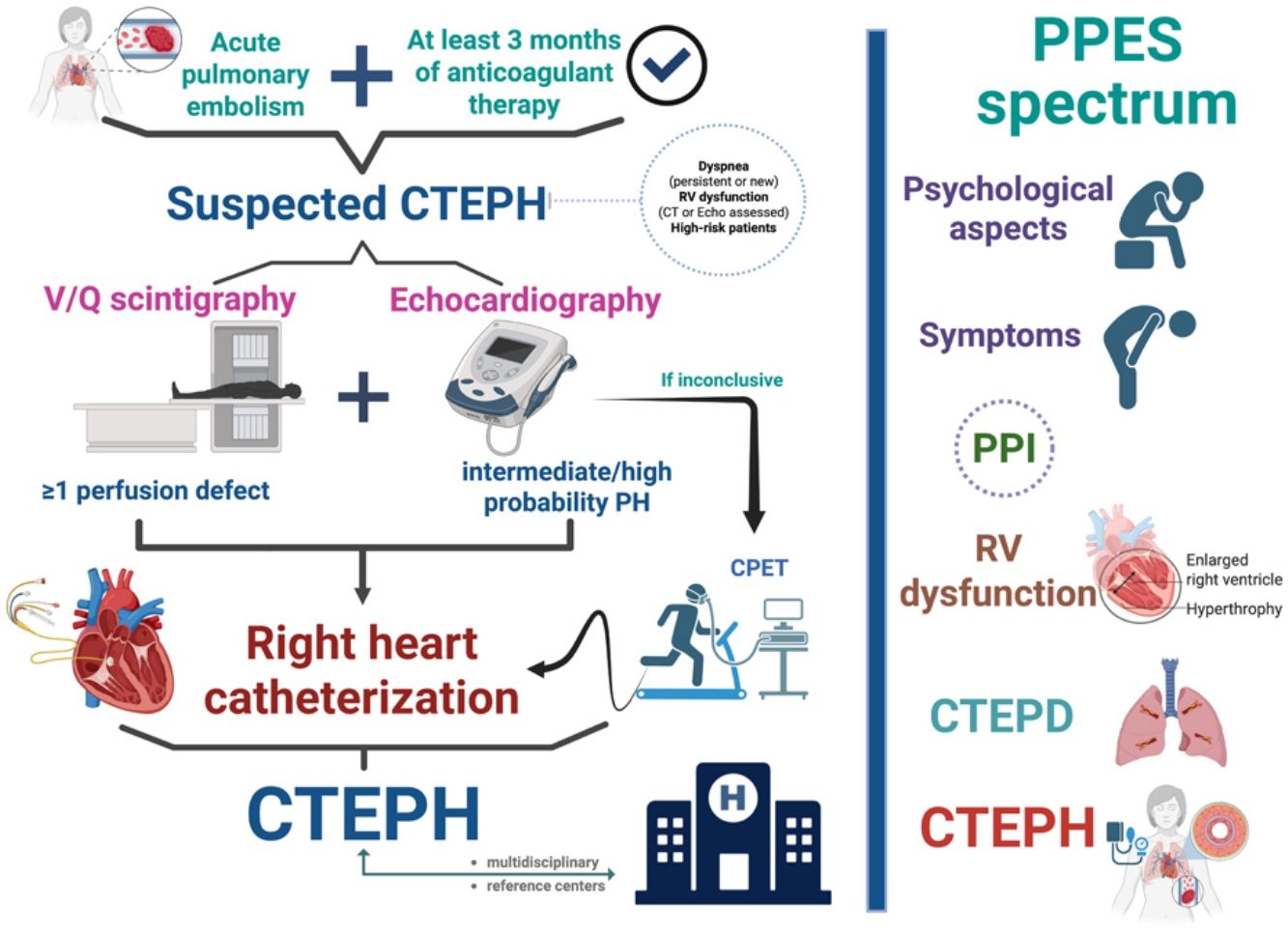
Post-pulmonary embolism syndrome (PPES) describes the spectrum of long-term sequelae following acute pulmonary embolism (PE), including persistent dyspnea, exercise intolerance, and psychological impairment, often in the absence of pulmonary hypertension (PH) or right ventricular (RV) abnormalities. Persistent RV dysfunction occurs in up to 18% of patients beyond three months and is associated with recurrent venous thromboembolism (VTE) and PE-related mortality. The FOCUS study introduced the concept of post-PE impairment (PPI), defined by a combination of echocardiographic RV dysfunction and clinical or functional deterioration, which predicted higher mortality, rehospitalization rates, and impaired quality of life. Chronic thromboembolic pulmonary disease (CTEPD) refers to symptomatic patients with residual perfusion defects but without PH. In contrast, chronic thromboembolic pulmonary hypertension (CTEPH) is defined by pre-capillary PH in the presence of residual obstruction, with a cumulative incidence of 0.5–4% within two years. Prognosis in CTEPH is driven primarily by RV dysfunction, but advances in multimodal therapies—surgical, interventional, and pharmacological—have improved survival, underscoring the importance of early recognition and systematic follow-up.

Keywords:
Chronic thromboembolic pulmonary hypertension
Post-pulmonary embolism syndrome
Pulmonary embolism
Residual thrombosis
Right ventricle dysfunction
Venous thromboembolism
Resumen

El síndrome post-embolia pulmonar describe el espectro de secuelas a largo plazo tras una embolia pulmonar (EP) aguda, que incluye disnea persistente, intolerancia al ejercicio y deterioro psicológico, a menudo en ausencia de hipertensión pulmonar (HP) o de alteraciones del ventrículo derecho (VD). La disfunción persistente del VD ocurre en hasta el 18% de los pacientes más allá de los tres meses y se asocia con recurrencia de tromboembolismo venoso y mortalidad relacionada con la EP. El estudio FOCUS introdujo el concepto de deterioro funcional post-EP, definido por la combinación de disfunción ecocardiográfica del VD y deterioro clínico o funcional, que predijo una mayor mortalidad, mayores tasas de rehospitalización y un empeoramiento de la calidad de vida. La enfermedad pulmonar tromboembólica crónica se refiere a pacientes sintomáticos con defectos residuales de perfusión pero sin HP. En contraste, la hipertensión pulmonar tromboembólica crónica (HPTEC) se define por HP precapilar en presencia de obstrucción residual, con una incidencia acumulada del 0,5–4% a los dos años. El pronóstico en la HPTEC está determinado principalmente por la disfunción del VD, pero los avances en terapias multimodales —quirúrgicas, intervencionistas y farmacológicas— han mejorado la supervivencia, lo que subraya la importancia del reconocimiento precoz y del seguimiento sistemático.
Palabras clave:
Hipertensión pulmonar tromboembólica crónica
Síndrome post-embolia pulmonar
Embolia pulmonar
Trombosis residual
Disfunción del ventrículo derecho
Enfermedad tromboembólica venosa
Graphical abstract

Article

These are the options to access the full texts of the publication Revista Clínica Española (English Edition)
Member
Si es usted socio de FESEMI siga los siguientes pasos:

Diríjase desde aquí a la web de la >>>https://www.fesemi.org/publicaciones/revista-clinica/noticias<<< e inicie sesión mediante el formulario que se encuentra en la barra superior, pulsando sobre el candado.

Deslice el cursor hacia abajo hasta la sección "PUBLICACIONES" y pinche en "Revista Clínica Española":

>>>https://www.fesemi.org/publicaciones/revista-clinica/noticias<<<


Subscriber
Subscriber

If you already have your login data, please click here .

If you have forgotten your password you can you can recover it by clicking here and selecting the option “I have forgotten my password”
Subscribe
Subscribe to
Revista Clínica Española (English Edition)
Purchase
Purchase article

Purchasing article the PDF version will be downloaded

Purchase now
Contact
Phone for subscriptions and reporting of errors
From Monday to Friday from 9 a.m. to 6 p.m. (GMT + 1) except for the months of July and August which will be from 9 a.m. to 3 p.m.
Calls from Spain
932 415 960
Calls from outside Spain
+34 932 415 960
Email
References
[1]
S.V. Konstantinides, G. Meyer, C. Becattini, ESC Scientific Document Group, et al.
2019 ESC Guidelines for the diagnosis and management of acute pulmonary embolism developed in collaboration with the European Respiratory Society (ERS).
Eur Heart J., 41 (2020), pp. 543-603
[2]
P. Demelo-Rodriguez, F. Galeano-Valle, A. Salzano, et al.
Pulmonary embolism: a practical guide for the busy clinician.
Heart Fail Clin., 16 (2020), pp. 317-330
[3]
F. Khan, T. Tritschler, S.R. Kahn.
Venous thromboembolism.
[4]
J.A. Heit.
Epidemiology of venous thromboembolism.
Nat Rev Cardiol., 12 (2015), pp. 464-474
[5]
M.J. Engbers, A. Hylckama Vlieg, F.R. Rosendaal.
Venous thrombosis in the elderly: incidence, risk factors and risk groups.
J Thromb Haemost., 8 (2010), pp. 2105-2112
[6]
F. Galeano-Valle, L. Ordieres-Ortega, C.M. Oblitas, et al.
Inflammatory biomarkers in the short-term prognosis of venous thromboembolism: a narrative review.
Int J Mol Sci., 22 (2021),
[7]
B. Engelmann, S. Massberg.
Thrombosis as an intravascular effector of innate immunity.
Nat Rev Immunol., 13 (2013), pp. 34-45
[8]
E. Vazquez-Garza, C. Jerjes-Sanchez, A. Navarrete, et al.
Venous thromboembolism: thrombosis, inflammation, and immunothrombosis for clinicians.
J Thromb Thrombolysis., 44 (2017), pp. 377-385
[9]
C.M. Oblitas, M.O. Lago-Rodríguez, M. López-Rubio, et al.
Role of cytokines in predicting early major bleeding in patients with acute pulmonary embolism.
Eur J Haematol., 114 (2025), pp. 847-851
[10]
C.M. Oblitas, M. López-Rubio, M.O. Lago-Rodríguez, et al.
Soluble urokinase type plasminogen activator receptor (suPAR) and mortality in acute pulmonary embolism.
Med Clin (Barc)., 163 (2024), pp. 281-285
[11]
R. Lecumberri, A. Alfonso, D. Jimenez, et al.
Dynamics of case-fatalilty rates of recurrent thromboembolism and major bleeding in patients treated for venous thromboembolism.
Thromb Haemost., 110 (2013), pp. 834-843
[12]
C. Chai-Adisaksopha, M. Crowther, T. Isayama, et al.
The impact of bleeding complications in patients receiving target-specific oral anticoagulants: a systematic review and meta-analysis.
Blood., 124 (2014), pp. 2450-2458
[13]
F.A. Klok, T. van der Hulle, P.L. den Exter, et al.
The post-PE syndrome: a new concept for chronic complications of pulmonary embolism.
Blood Rev., 28 (2014), pp. 221-226
[14]
M. Humbert, G. Kovacs, M.M. Hoeper, ESC/ERS Scientific Document Group, et al.
2022 ESC/ERS Guidelines for the diagnosis and treatment of pulmonary hypertension.
[15]
L. Valerio, A.C. Mavromanoli, S. Barco, FOCUS Investigators, et al.
Chronic thromboembolic pulmonary hypertension and impairment after pulmonary embolism: the FOCUS study.
Eur Heart J., 43 (2022), pp. 3387-3398
[16]
S. Fischer, C. Meisinger, J. Linseisen, et al.
Depression and anxiety up to two years after acute pulmonary embolism: prevalence and predictors.
Thromb Res., 222 (2023), pp. 68-74
[17]
I. Kirchberger, S. Fischer, T.M. Berghaus, et al.
Dyspnea after a first episode of pulmonary embolism: prevalence, predictors and long-term associations with health-related quality of life.
Front Cardiovasc Med, 12 (2025),
[18]
D. Luijten, C.M.M. de Jong, M.K. Ninaber, et al.
Post-pulmonary embolism syndrome and functional outcomes after acute pulmonary embolism.
Semin Thromb Hemost., 49 (2023), pp. 848-860
[19]
A.K. Sista, L.E. Miller, S.R. Kahn, et al.
Persistent right ventricular dysfunction, functional capacity limitation, exercise intolerance, and quality of life impairment following pulmonary embolism: systematic review with meta-analysis.
Vasc Med., 22 (2017), pp. 37-43
[20]
S. Vanni, P. Nazerian, G. Pepe, et al.
Comparison of two prognostic models for acute pulmonary embolism: clinical vs. right ventricular dysfunction-guided approach.
J Thromb Haemost, 9 (2011), pp. 1916-1923
[21]
C. Becattini, G. Maraziti, D.R. Vinson, et al.
Right ventricle assessment in patients with pulmonary embolism at low risk for death based on clinical models: an individual patient data meta-analysis.
Eur Heart J, 42 (2021), pp. 3190-3199
[22]
A.C. Mavromanoli, S. Barco, W. Ageno, PEITHO-2 Investigators, et al.
Recovery of right ventricular function after intermediate-risk Pulmonary Embolism: results from the multicentre Pulmonary Embolism International Trial (PEITHO)-2.
Clin Res Cardiol., 112 (2023), pp. 1372-1381
[23]
J.A. Kline, M.T. Steuerwald, M.R. Marchick, et al.
Prospective evaluation of right ventricular function and functional status 6 months after acute submassive pulmonary embolism: frequency of persistent or subsequent elevation in estimated pulmonary artery pressure.
Chest., 136 (2009), pp. 1202-1210
[24]
S. Grifoni, S. Vanni, S. Magazzini, et al.
Association of persistent right ventricular dysfunction at hospital discharge after acute pulmonary embolism with recurrent thromboembolic events.
Arch Intern Med., 166 (2006), pp. 2151-2156
[25]
I.T. Farmakis, L. Valerio, S. Barco, et al.
Functional capacity and dyspnea during follow-up after acute pulmonary embolism.
J Thromb Haemost., 22 (2024), pp. 163-171
[26]
P.L. den Exter, J. van Es, L.J. Kroft, Prometheus Follow-Up Investigators, et al.
Thromboembolic resolution assessed by CT pulmonary angiography after treatment for acute pulmonary embolism.
Thromb Haemost., 114 (2015), pp. 26-34
[27]
M. Ak, S. Gumus, A. Aghayev, et al.
The resolution rate of pulmonary embolism on CT pulmonary angiography: a prospective study.
[28]
O. Sanchez, D. Helley, S. Couchon, et al.
Perfusion defects after pulmonary embolism: risk factors and clinical significance.
J Thromb Haemost., 8 (2010), pp. 1248-1255
[29]
R. Pesavento, L. Filippi, A. Palla, SCOPE Investigators, et al.
Impact of residual pulmonary obstruction on the long-term outcome of patients with pulmonary embolism.
[30]
G. Simonneau, M.A. Gatzoulis, I. Adatia, et al.
Updated clinical classification of pulmonary hypertension.
J Am Coll Cardiol., 62 (2013), pp. D34-41
[31]
P.M. Hassoun.
Pulmonary arterial hypertension.
N Engl J Med., 385 (2021), pp. 2361-2376
[32]
A. Mocumbi, M. Humbert, A. Saxena, et al.
Pulmonary hypertension.
Nat Rev Dis Primers., 10 (2024), pp. 1
[33]
D.T. Wijeratne, K. Lajkosz, S.B. Brogly, et al.
Increasing incidence and prevalence of World Health Organization groups 1 to 4 pulmonary hypertension: a population-based cohort study in Ontario, Canada.
Circ Cardiovasc Qual Outcomes., 11 (2018),
[34]
N. Coquoz, D. Weilenmann, D. Stolz, et al.
Multicentre observational screening survey for the detection of CTEPH following pulmonary embolism.
[35]
Y.M. Ende-Verhaar, S.C. Cannegieter, A. Vonk Noordegraaf, et al.
Incidence of chronic thromboembolic pulmonary hypertension after acute pulmonary embolism: a contemporary view of the published literature.
[36]
J. Pepke-Zaba, M. Delcroix, I. Lang, et al.
Chronic thromboembolic pulmonary hypertension (CTEPH): results from an international prospective registry.
Circulation., 124 (2011), pp. 1973-1981
[37]
D. Bonderman, H. Wilkens, S. Wakounig, et al.
Risk factors for chronic thromboembolic pulmonary hypertension.
Eur Respir J., 33 (2009), pp. 325-331
[38]
I.M. Lang, G. Simonneau, J.W. Pepke-Zaba, et al.
Factors associated with diagnosis and operability of chronic thromboembolic pulmonary hypertension. A case-control study.
Thromb Haemost., 110 (2013), pp. 83-91
[39]
A. Ruggiero, N.J. Screaton.
Imaging of acute and chronic thromboembolic disease: state of the art.
Clin Radiol., 72 (2017), pp. 375-388
[40]
D. Gopalan, M. Delcroix, M. Held.
Diagnosis of chronic thromboembolic pulmonary hypertension.
[41]
F.A. Klok, O. Dzikowska-Diduch, M. Kostrubiec, et al.
Derivation of a clinical prediction score for chronic thromboembolic pulmonary hypertension after acute pulmonary embolism.
J Thromb Haemost., 14 (2016), pp. 121-128
[42]
T. Kiko, R. Asano, Y. Yoshikawa, et al.
Survival trends in patients with chronic thromboembolic pulmonary hypertension: an observational study.
[43]
N.H. Kim, A.M. D’Armini, M. Delcroix, et al.
Chronic thromboembolic pulmonary disease.
[44]
D. Kylhammar, B. Kjellström, C. Hjalmarsson, et al.
A comprehensive risk stratification at early follow-up determines prognosis in pulmonary arterial hypertension.
Eur Heart J., 39 (2018), pp. 4175-4181
[45]
M. Delcroix, G. Staehler, H. Gall, et al.
Risk assessment in medically treated chronic thromboembolic pulmonary hypertension patients.
[46]
J. Arthur Ataam, M. Amsallem, J. Guihaire, et al.
Preoperative C-reactive protein predicts early postoperative outcomes after pulmonary endarterectomy in patients with chronic thromboembolic pulmonary hypertension.
J Thorac Cardiovasc Surg., 161 (2021), pp. 1532-1542.e5
[47]
J. Brito, P. Alves da Silva, D. Inácio Cazeiro, et al.
Multidimensional CT approach to predict hemodynamics in pulmonary hypertension.
Clin Radiol., 79 (2024), pp. 921-930
[48]
A. Fauché, E. Presles, O. Sanchez, PADIS-PE Investigators, et al.
Frequency and predictors for chronic thromboembolic pulmonary hypertension after a first unprovoked pulmonary embolism: results from PADIS studies.
J Thromb Haemost., 20 (2022), pp. 2850-2861
Idiomas
Revista Clínica Española (English Edition)
Article options
Tools
