

Suggestions
Idioma
Guide for authors
Searcher
Journal Information
Vol. 226. Issue 6.
(June - July 2026)
Cite
Cite
Share
Download PDF
More article options
Visits
640
Vol. 226. Issue 6.
(June - July 2026)
Original article

Pharmacological and interventional strategies for chronic Chagas cardiomyopathy: a systematic review of clinical outcomes

Estrategias farmacológicas e intervencionistas en la cardiomiopatía chagásica crónica: revisión sistemática de desenlaces clínicos
Visits
640
G. Ramírez-Olivenciaa,b,
Corresponding author
germanro.76@gmail.com

Corresponding author.
, C. Muñoz Nietob, M. Fernández Tomása, D. Martí Sánchezc
a HLIU, CBRN-Infectious Diseases, Hospital Central de la Defensa Gómez Ulla CSVE, Gta, Ejército s/n. 280247, Madrid, Spain
b University of Alcalá, Madrid, Spain
c Department of Cardiology, Hospital Central de la Defensa Gómez Ulla CSVE, Madrid, Spain
This item has received
Article information
Abstract
Full Text
Bibliography
Download PDF
Statistics
Abstract
Background

Chronic Chagas Cardiomyopathy (CCC), the main chronic manifestation ofTrypanosoma cruzi infection, is a major global health burden causing heart failure, arrhythmias, and sudden death. Despite recommendations for conventional heart failure therapies, specific evidence for non-antiparasitic interventions in CCC is limited, creating significant clinical uncertainty.

Objectives

This systematic review aimed to synthesize the available evidence from Randomized Controlled Trials (RCTs) regarding the efficacy and safety of non-antiparasitic pharmacological and device-based therapies in CCC, specifically focusing on hard clinical outcomes such as mortality and hospitalizations.

Methods

We conducted a systematic search following PRISMA guidelines in PubMed, Web of Science, LILACS, MEDLINE, and BVS on May 1, 2025 (coverage through April 30, 2025; see Appendix 1). Blinded RCTs in adults with CCC evaluating non-antiparasitic therapies were included. The methodological quality was assessed using the Cochrane Risk of Bias (RoB) tool, and a narrative synthesis was performed due to clinical heterogeneity.

Results

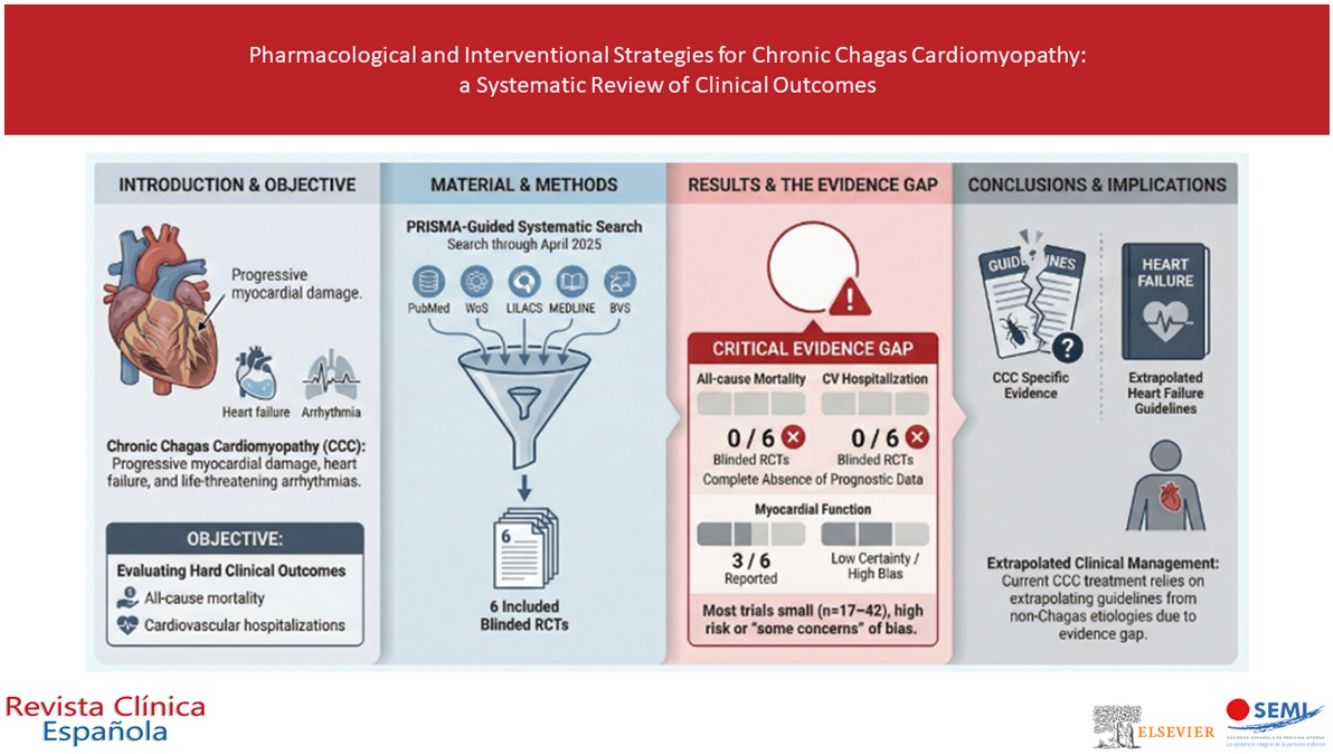
Six blinded RCTs were included. The primary finding is a notable gap: none of the six included RCTs reported data on all-cause mortality or cardiovascular hospitalizations. Conventional agents (e.g., carvedilol, ACE inhibitors) did not demonstrate consistent benefit in improving myocardial function. Antiarrhythmic drugs showed partial efficacy but were associated with unfavorable risk-benefit profiles or a high/uncertain risk of bias.

Conclusions

There is a limited evidence of robust, reliable evidence from blinded RCTs to guide non-antiparasitic therapeutic strategies in CCC. This notable gap precludes establishing evidence-based recommendations for prognostic management. Consequently, management must continue to rely on extrapolated data from general heart failure guidelines. Urgent funding and execution of adequately powered RCTs that address hard clinical endpoints are necessary.

Keywords:
Chagas cardiomyopathy
Heart failure
Pharmacological treatment
Implantable devices
Arrhythmias
Systematic review
Resumen
Antecedentes

La cardiomiopatía chagásica crónica (CCC) continúa siendo una importante carga sanitaria mundial, con características clínicas propias y opciones terapéuticas limitadas más allá del tratamiento antiparasitario. A pesar de su relevancia, no existe una revisión sistemática que evalúe de forma integral las estrategias farmacológicas e intervencionistas no antiparasitarias en la CCC.

Objetivos

Sintetizar la evidencia procedente de ensayos clínicos aleatorizados (ECA) sobre la eficacia y seguridad de intervenciones farmacológicas y dispositivos en la CCC.

Métodos

Se realizó una búsqueda sistemática siguiendo las guías PRISMA en PubMed, Web of Science, LILACS, MEDLINE y BVS el 1 de mayo de 2025 (cobertura hasta el 30 de abril de 2025; ver Apéndice 1). Se incluyeron ECA cegados en adultos con CCC que evaluaran terapias no antiparasitarias. La calidad metodológica se evaluó mediante la herramienta Cochrane Risk of Bias (RoB), y se realizó una síntesis narrativa debido a la heterogeneidad clínica.

Resultados

De 65 registros identificados, 6 ECA cumplieron los criterios de inclusión. Las intervenciones incluyeron carvedilol, enalapril, disopiramida, carbamazepina, piridostigmina y estrategias de estimulación cardíaca. Ningún ECA cegado informó sobre desenlaces clínicos duros como mortalidad u hospitalizaciones. La mayoría de los estudios fueron pequeños, unicéntricos y con riesgo de sesgo alto o incierto. La evidencia sugirió posibles beneficios en desenlaces subrogados (función ventricular izquierda, control de arritmias), aunque los resultados fueron inconsistentes.

Conclusiones

La evidencia actual sobre terapias no antiparasitarias en la CCC es escasa, heterogénea y de baja certeza. Se necesitan con urgencia ECA robustos y con suficiente potencia para establecer la eficacia de terapias modernas de insuficiencia cardíaca (ARNIs, inhibidores de SGLT2) y de intervenciones con dispositivos en esta población.
Palabras clave:
Enfermedad de Chagas
Miocardiopatía
Revisión sistemática
Ensayos clínicos aleatorizados
Terapias para insuficiencia cardíaca
Graphical abstract

Article

These are the options to access the full texts of the publication Revista Clínica Española (English Edition)
Member
Si es usted socio de FESEMI siga los siguientes pasos:

Diríjase desde aquí a la web de la >>>https://www.fesemi.org/publicaciones/revista-clinica/noticias<<< e inicie sesión mediante el formulario que se encuentra en la barra superior, pulsando sobre el candado.

Deslice el cursor hacia abajo hasta la sección "PUBLICACIONES" y pinche en "Revista Clínica Española":

>>>https://www.fesemi.org/publicaciones/revista-clinica/noticias<<<


Subscriber
Subscriber

If you already have your login data, please click here .

If you have forgotten your password you can you can recover it by clicking here and selecting the option “I have forgotten my password”
Subscribe
Subscribe to
Revista Clínica Española (English Edition)
Purchase
Purchase article

Purchasing article the PDF version will be downloaded

Purchase now
Contact
Phone for subscriptions and reporting of errors
From Monday to Friday from 9 a.m. to 6 p.m. (GMT + 1) except for the months of July and August which will be from 9 a.m. to 3 p.m.
Calls from Spain
932 415 960
Calls from outside Spain
+34 932 415 960
Email
References
[1]
Enfermedad de Chagas (tripanosomiasis americana) [Internet]. [cited 2025 May 2]. Available from: https://www.who.int/es/news-room/fact-sheets/detail/chagas-disease-(american-trypanosomiasis).
[2]
L. Basile, J.M. Jansà, Y. Carlier, et al.
Chagas disease in European countries: the challenge of a surveillance system.
[3]
R.M. Saraiva, M.F.F. Mediano, F.S.N.S. Mendes, et al.
Chagas heart disease: an overview of diagnosis, manifestations, treatment, and care.
World J Cardiol, 13 (2021), pp. 654-675
[4]
M.C.P. Nunes, C. Bern, E.H. Clark, A.L. Teixeira, I. Molina.
Clinical features of Chagas disease progression and severity.
Lancet Reg Health Am, 37 (2024),
[5]
A.S. de Sousa, D. Vermeij, A.N. Ramos, A.O. Luquetti.
Chagas disease.
[6]
M.C. Swett, D.L. Rayes, S.V. Campos, R.N. Kumar.
Chagas disease: epidemiology, diagnosis, and treatment.
Curr Cardiol Rep, 26 (2024), pp. 1105-1112
[7]
I.G. Montalvo-Ocotoxtle, G. Rojas-Velasco, O. Rodríguez-Morales, et al.
Chagas heart disease: beyond a single complication, from asymptomatic disease to heart failure.
J Clin Med, 11 (2022),
[8]
W. Nadruz, L. Gioli-Pereira, S. Bernardez-Pereira, et al.
Temporal trends in the contribution of Chagas cardiomyopathy to mortality among patients with heart failure.
Heart, 104 (2018), pp. 1522-1528
[9]
M.C.P. Nunes, A. Beaton, H. Acquatella, et al.
Chagas cardiomyopathy: an update of current clinical knowledge and management: a scientific statement from the American Heart Association.
Circulation, 138 (2018), pp. e169-209
[10]
L. Shen, F. Ramires, F. Martinez, et al.
Contemporary characteristics and outcomes in chagasic heart failure compared with other nonischemic and ischemic cardiomyopathy.
Circ Heart Fail, 10 (2017),
[11]
S. Gonzaga BM de, R.R. Ferreira, L.L. Coelho, A.C.C. Carvalho, L.R. Garzoni, T.C. Araujo-Jorge.
Clinical trials for Chagas disease: etiological and pathophysiological treatment.
Front Microbiol, 14 (2023),
[12]
L.G. Ramos, K.R. de Souza, P.A.S. Júnior, et al.
Tackling the challenges of human Chagas disease: a comprehensive review of treatment strategies in the chronic phase and emerging therapeutic approaches.
Acta Tropica, 256 (2024),
[13]
C.A. Morillo, J.A. Marin-Neto, A. Avezum, et al.
Randomized trial of benznidazole for chronic Chagas’ cardiomyopathy.
N Engl J Med, 373 (2015), pp. 1295-1306
[14]
C.A. Morillo, H. Waskin, S. Sosa-Estani, M. del Carmen Bangher, et al.
Benznidazole and posaconazole in eliminating parasites in asymptomatic T. Cruzi carriers: the STOP-CHAGAS trial.
J Am Coll Cardiol, 69 (2017), pp. 939-947
[15]
I. Molina, J. Gómez i Prat, F. Salvador, et al.
Randomized trial of posaconazole and benznidazole for chronic Chagas’ disease.
N Engl J Med, 370 (2014), pp. 1899-1908
[16]
M.J. Page, J.E. McKenzie, P.M. Bossuyt, et al.
The PRISMA 2020 statement: an updated guideline for reporting systematic reviews.
BMJ, 372 (2021),
[17]
J.A.C. Sterne, J. Savović, M.J. Page, et al.
RoB 2: a revised tool for assessing risk of bias in randomised trials.
BMJ, 366 (2019),
[18]
F.A. Botoni, P.A. Poole-Wilson, A.L.P. Ribeiro, et al.
A randomized trial of carvedilol after renin-angiotensin system inhibition in chronic Chagas cardiomyopathy.
Am Heart J, 153 (2007), pp. 544.e1-544.e8
[19]
R.R. Roberti, E.E. Martinez, J.L. Andrade, et al.
Chagas cardiomyopathy and captopril.
[20]
L. Antonio, C. Teno, R. Costa, et al.
Upgrading from VVI to DDD pacing mode during elective replacement of pulse generator. A comparative clinical-functional analysis.
Arq Bras Cardiol, 88 (2007), pp. 128-133
[21]
H.A. Carrasco, A.V. Vicuña, C. Molina, et al.
Effect of low oral doses of disopyramide and amiodarone on ventricular and atrial arrhythmias of chagasic patients with advanced myocardial damage.
[22]
A. Payares, H.A. Carrasco, D. Durán, C. Molina, R. Ortiz, D. Violi.
The anti-arrhythmia effect of carbamazepine in chagasic patients with advanced myocardial damage.
Arch Inst Cardiol Mex, 63 (1993), pp. 241-246
[23]
R.R.T. Castro, G. Porphirio, S.S. Xavier, et al.
Cholinesterase inhibition reduces arrhythmias in asymptomatic Chagas disease.
Cardiovasc Ther, 35 (2017),
[24]
M. Martinelli-Filho, J.A. Marin-Neto, M.I. Scanavacca, et al.
Amiodarone or implantable cardioverter-defibrillator in Chagas cardiomyopathy: the ChagasICS randomized clinical trial.
JAMA Cardiol, 9 (2024), pp. 1073-1081
[25]
E.A. Bocchi, L.E. Echeverria, C. Demacq, et al.
Sacubitril/Valsartan versus Enalapril in chronic Chagas cardiomyopathy: rationale and design of the PARACHUTE-HF trial.
JACC Heart Fail, 12 (2024), pp. 1473-1486
[26]
E.A. Bocchi, S. Rassi, G.V. Guimarães.
Safety profile and efficacy of ivabradine in heart failure due to Chagas heart disease: a post hoc analysis of the SHIFT trial.
ESC Heart Fail, 5 (2018), pp. 249-256
[27]
R. Hidalgo, A.J. Martí-Carvajal, J.S. Kwong, D. Simancas-Racines, S. Nicola.
Pharmacological interventions for treating heart failure in patients with Chagas cardiomyopathy.
Cochrane database of systematic reviews, John Wiley & Sons, Ltd., (2012),
Idiomas
Revista Clínica Española (English Edition)
Article options
Tools
Supplemental materials
