

Suggestions
Idioma
Guide for authors
Searcher
Journal Information
Cite
Cite
Share
Download PDF
More article options
Visits
11887
Documento de consenso

Insuficiencia cardíaca con fracción de eyección preservada: actualización en estrategias diagnósticas y terapéuticas. Documento de consenso de la SEMI

Heart failure with preserved ejection fraction: updated diagnostic and therapeutic strategies. SEMI consensus document
Visits
11887
J.M. Fernández Rodrígueza,
Corresponding author
chemachir@hotmail.com

Autor para correspondencia.
, M.B. Alonso-Ortízb, J. Casado Cerradac,d, D. Chivite Guillene,f, P. Cubo Romanog, R. García Alonsoh, A. Lorenzo Almorósi, J.P. Miramontes-Gonzálezj, L. Soler Rangelk, J. Pérez-Silvestrel
a UMIPIC, Unidad de Gestión Clínica de Medicina Interna, Hospital Universitario Central de Asturias, Oviedo, España
b Servicio de Medicina Interna, Hospital Universitario de Gran Canaria Doctor Negrín. Departamento de Ciencias Médicas y Quirúrgicas, Universidad de Las Palmas de Gran Canaria, Las Palmas de Gran Canaria, España
c Servicio de Medicina Interna, Hospital Universitario de Getafe, Getafe, Madrid, España
d Departamento de Medicina, Facultad de Medicina, Salud y Deportes, Universidad Europea de Madrid, Madrid, España
e Servicio de Medicina Interna - IDIBELL, Hospital Universitari de Bellvitge, L’Hospitalet de Llobregat, España
f Departamento de Ciencias Clínicas, Facultad de Medicina y Ciencias de la Salud, Universidad de Barcelona (campus Bellvitge), L’Hospitalet de Llobregat, España
g Coordinadora del grupo de trabajo de Cronicidad y Pluripatología de la Sociedad Española de Medicina Interna. Servicio de Medicina Interna, Hospital Universitario Infanta Cristina, Parla, Madrid, España
h Servicio de Medicina Interna, Complejo Asistencial de Ávila, Ávila, España
i Servicio de Medicina Interna, Hospital General Universitario Gregorio Marañón. Profesora Asociada Universidad Complutense de Madrid (UCM). Instituto de Investigaciones Sanitarias Gregorio Marañón (IiSGM), Madrid, España
j Departamento de Medicina, Facultad de Medicina, Universidad de Valladolid. Servicio de Medicina Interna, Hospital Universitario Río Hortega, Valladolid, España
k Servicio de Medicina Interna, Hospital Universitario Infanta Sofía. Facultad de Medicina, Salud y Deportes, Universidad Europea de Madrid. FIIB HUIS-HUHEN, San Sebastián de los Reyes, Madrid, España
l UMIPIC, Servicio de Medicina Interna, Consorcio Hospital General Universitario de Valencia, Valencia, España
Ver más
This item has received
Article information
Abstract
Full Text
Bibliography
Download PDF
Statistics
Resumen

La insuficiencia cardíaca (IC) está asociada con una elevada morbimortalidad. La IC con fracción de eyección del ventrículo izquierdo preservada (IC-FEp) alcanza hasta el 50% de todos los casos de IC, siendo la más frecuente en los pacientes añosos. Además, estos sujetos suelen presentar frecuentemente otras comorbilidades. Por todo ello, el diagnóstico de los pacientes con IC-FEp es complejo y requiere de un abordaje cuidadoso. Además, existen formas «secundarias» o que simulan IC-FEp que también es necesario descartar. El tratamiento de la IC-FEp ha evolucionado de manera muy importante en los últimos años debido a las evidencias provenientes de los ensayos clínicos. Hasta hace pocos años su manejo se basaba en el tratamiento de los síntomas congestivos con diuréticos y las comorbilidades; a esto se añadió la indicación de tratamiento con los inhibidores SGLT2, tras haberse demostrado que reducen las hospitalizaciones por IC, y más recientemente se han publicado nuevas evidencias de beneficio clínico con otros fármacos como la finerenona, la semaglutida o la tirzepatida. Todo esto hace que sea necesario actualizar las recomendaciones acerca del manejo del paciente con IC-FEp.

Palabras clave:
Insuficiencia cardíaca con fracción de eyección preservada
Diagnóstico
Inhibidores del cotransportador sodio-glucosa tipo2
Sacubitrilo-valsartán
Finerenona
Semaglutida
Tirzepatida
Síndrome cardiorrenal
Abstract

Heart failure (HF) is associated with high morbidity and mortality. HF with preserved left ventricular ejection fraction (HF-pEF) accounts for up to 50% of all HF cases, being the most common in elderly patients. In addition, these subjects frequently present other comorbidities. For all these reasons, the diagnosis of patients with HF-pEF is complex and requires a careful approach. In addition, there are «secondary» or HF-pEF forms that must also be discarded. The treatment of HF-pEF has evolved very significantly in recent years due to evidence from clinical trials. Until a few years ago, the management was based on the treatment of congestive symptoms with diuretics and comorbidities, to this was added the indication of treatment with SGLT2 inhibitors, after being shown to reduce hospitalizations due to HF, and more recently new evidence of clinical benefit with other drugs such as finerenone, semaglutide or tirzepatide has been published. All this makes it necessary to update the recommendations regarding the management of patients with HF-pEF.
Keywords:
Heart failure with preserved ejection fraction
Diagnosis
Sodium-glucose transporter2 inhibitors
Sacubitril-valsartan
Finerenone
Semaglutide
Tirzepatide
Cardiorenal syndrome
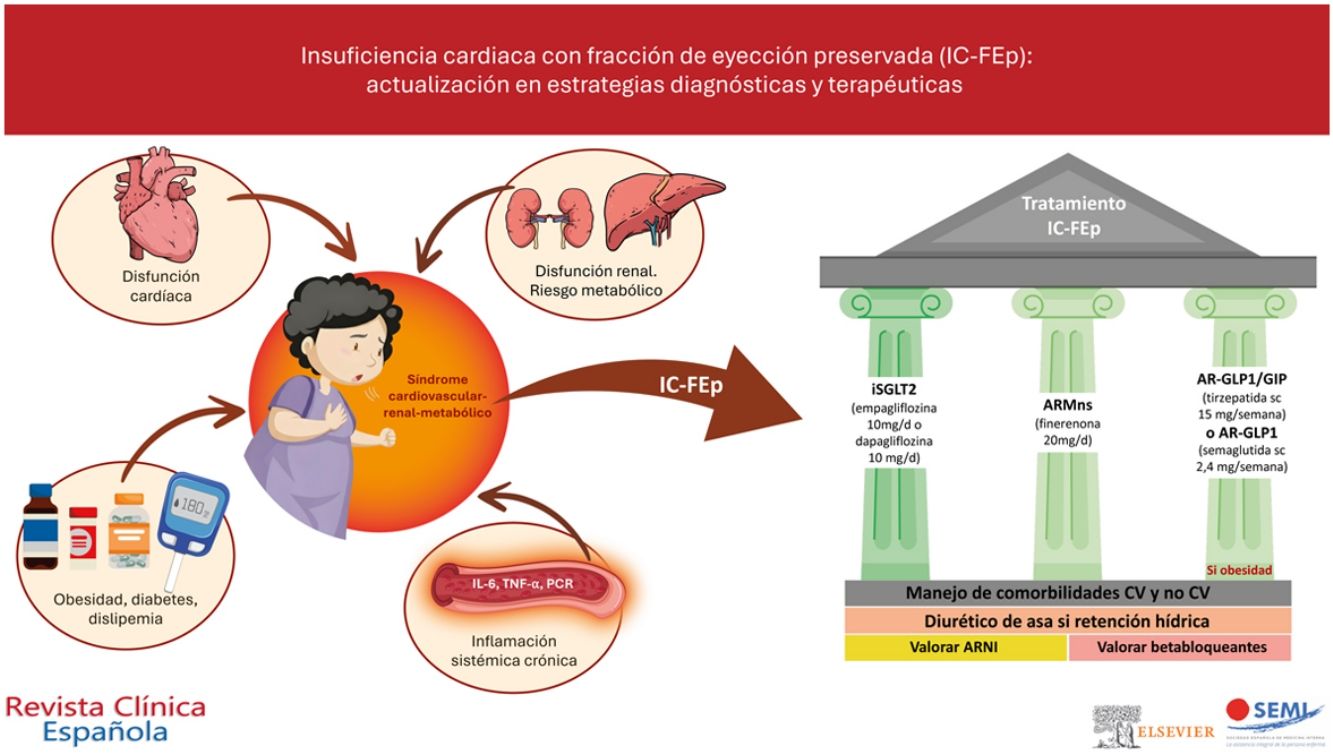
Graphical abstract

Article

These are the options to access the full texts of the publication Revista Clínica Española (English Edition)
Member
Si es usted socio de FESEMI siga los siguientes pasos:

Diríjase desde aquí a la web de la >>>https://www.fesemi.org/publicaciones/revista-clinica/noticias<<< e inicie sesión mediante el formulario que se encuentra en la barra superior, pulsando sobre el candado.

Deslice el cursor hacia abajo hasta la sección "PUBLICACIONES" y pinche en "Revista Clínica Española":

>>>https://www.fesemi.org/publicaciones/revista-clinica/noticias<<<


Subscriber
Subscriber

If you already have your login data, please click here .

If you have forgotten your password you can you can recover it by clicking here and selecting the option “I have forgotten my password”
Subscribe
Subscribe to
Revista Clínica Española (English Edition)
Purchase
Purchase article

Purchasing article the PDF version will be downloaded

Purchase now
Contact
Phone for subscriptions and reporting of errors
From Monday to Friday from 9 a.m. to 6 p.m. (GMT + 1) except for the months of July and August which will be from 9 a.m. to 3 p.m.
Calls from Spain
932 415 960
Calls from outside Spain
+34 932 415 960
Email
Bibliografía
[1]
T.A. McDonagh, M. Metra, M. Adamo, et al.
2021 ESC Guidelines for the diagnosis and treatment of acute and chronic heart failure.
Eur Heart J., 42 (2021), pp. 3599-3726
[2]
M.S. Khan, I. Shahid, A. Bennis, A. Rakisheva, M. Metra, J. Butler.
Global epidemiology of heart failure.
Nat Rev Cardiol., 21 (2024), pp. 717-734
[3]
S.S. Martin, A.W. Aday, N.B. Allen, et al.
2025 heart disease and stroke statistics: a report of US and global data from the American Heart Association.
Circulation., 151 (2025), pp. e41-e660
[4]
P.M. Seferović, P. Vardas, E.A. Jankowska, et al.
The heart failure association atlas: heart failure epidemiology and management statistics 2019.
Eur J Heart Fail., 23 (2021), pp. 906-914
[5]
C. Escobar, B. Palacios, L. Varela, et al.
Prevalence, characteristics, management and outcomes of patients with heart failure with preserved, mildly reduced, and reduced ejection fraction in Spain.
J Clin Med., 11 (2022), pp. 5199
[6]
A. Sicras-Mainar, A. Sicras-Navarro, B. Palacios, L. Varela, J.F. Delgado.
Epidemiología y tratamiento de la insuficiencia cardiaca en España: estudio PATHWAYS-HF.
Rev Esp Cardiol (Engl Ed)., 75 (2022), pp. 31-38
[7]
R.K. Cheng, M. Cox, M.L. Neely, et al.
Outcomes in patients with heart failure with preserved, borderline, and reduced ejection fraction in the Medicare population.
Am Heart J., 168 (2014), pp. 721-730
[8]
O. Chioncel, M. Lainscak, P.M. Seferovic, et al.
Epidemiology and one-year outcomes in patients with chronic heart failure and preserved, mid-range and reduced ejection fraction: an analysis of the ESC Heart Failure Long-Term Registry.
Eur J Heart Fail., 19 (2017), pp. 1574-1585
[9]
C.E. Dumile, J. Rangaswami, S.L. Chow, American Heart Association, et al.
Cardiovascular-kidney-metabolic health: a presidential advisory from the American Heart Association.
Circulation., 148 (2023), pp. 1606-1635
[10]
M.M. Kittleson, G.S. Panjrath, K. Amancherla, et al.
2023 ACC Expert consensus decision pathway on management of heart failure with preserved ejection fraction: a report of the American College of Cardiology solution set oversight committee.
J Am Coll Cardiol., 81 (2023), pp. 1835-1878
[11]
A. Cannata, T.A. McDonagh.
Heart failure with preserved ejection fraction.
N Engl J Med., 392 (2025), pp. 173-184
[12]
A. Cannata, L. Camparini, G. Sinagra, M. Giacca, F.S. Loffredo.
Pathways for salvage and protection of the heart under stress: novel routes for cardiac rejuvenation.
Cardiovasc Res., 111 (2016), pp. 142-153
[13]
C.E. Hamo, C. DeJong, N. Hartshorne-Evans, et al.
Heart failure with preserved ejection fraction.
Nat Rev Dis Primers., 10 (2024), pp. 55
[14]
T.A. McDonagh, M. Metra, M. Adamo, et al.
2023 focused update of the 2021 ESC guidelines for the diagnosis and treatment of acute and chronic heart failure.
Eur Heart J., (2023), pp. 3627-3639
[15]
A. Peikert, S.D. Solomon.
Contemporary treatment options in heart failure with preserved ejection fraction.
Eur Heart J Cardiovasc Imaging., 25 (2024), pp. 1517-1524
[16]
A. Beghini, A.M. Sammartino, Z. Papp, et al.
2024 update in heart failure.
ESC Heart Fail., 12 (2025), pp. 8-42
[17]
P. Campbell, F.H. Rutten, M.M. Lee, N.M. Hawkins, M.C. Petrie.
Heart failure with preserved ejection fraction: everything the clinician needs to know.
Lancet., 403 (2024), pp. 1083-1092
[18]
B.A. Borlaug, K. Sharma, S.J. Shah, J.E. Ho.
Heart failure with preserved ejection fraction: JACC scientific statement.
J Am Coll Cardiol., 81 (2023), pp. 1810-1834
[19]
T.E. Owan, M.M. Redfield.
Epidemiology of diastolic heart failure.
Prog Cardiovasc Dis., 47 (2005), pp. 320-332
[20]
C.E. Ndumele, I.J. Neeland, K.R. Tuttle, et al.
A synopsis of the evidence for the science and clinical management of Cardiovascular-Kidney-Metabolic (CKM) syndrome: a scientific statement from the American Heart Association.
Circulation., 148 (2023), pp. 1636-1664
[21]
B.J. Van Essen, J.E. Emmens, J. Tromp, et al.
Sex-specific risk factors for new-onset heart failure: the PREVEND study at 25years.
Eur Heart J., 46 (2025), pp. 1528-1536
[22]
P. Goyal, O. Zainul, Y. Sharma, et al.
Geriatric vulnerabilities among adults with heart failure with preserved ejection fraction: a cross-continent evaluation.
JACC Adv., 4 (2025),
[23]
M. Anguita-Gámez, J.L. Bonilla-Palomas, A. Recio-Mayoral, et al.
Differences in clinical features and 1-year outcomes of patients with heart failure and reduced, mildly reduced, and preserved ejection fraction in a contemporary cohort: is the clinical profile changing?.
[24]
A. Shahim, M. Hourqueig, E. Donal, et al.
Predictors of long-term outcome in heart failure with preserved ejection fraction: a follow-up from the KaRen study.
ESC Heart Fail., 8 (2021), pp. 4243-4254
[25]
Meta-analysis Global Group in Chronic Heart Failure (MAGGIC).
The survival of patients with heart failure with preserved or reduced left ventricular ejection fraction: an individual patient data meta-analysis.
Eur Heart J., 33 (2012), pp. 1750-1757
[26]
J.C. Trullàs, J.I. Pérez-Calvo, A. Conde-Martel, et al.
Epidemiology of heart failure with preserved ejection fraction: results from the RICA Registry.
Med Clin (Barc)., 157 (2021), pp. 1-9
[27]
N.R. Jones, A.K. Roalfe, I. Adoki, F.D.R. Hobbs, C.J. Taylor.
Survival of patients with chronic heart failure in the community: a systematic review and meta-analysis.
Eur J Heart Fail., 21 (2019), pp. 1306-1325
[28]
M.G. Crespo-Leiro, E. Barge-Caballero, J. Segovia-Cubero, et al.
Pronóstico al año en pacientes con insuficiencia cardiaca en España. Registro ESC-EORP-HFA Heart Failure Long-Term.
REC: CardioClinics., 55 (2020), pp. 207-216
[29]
A. Kimmoun, K. Takagi, E. Gall, et al.
Temporal trends in mortality and readmission after acute heart failure: a systematic review and meta-regression in the past four decades.
Eur J Heart Fail., 23 (2021), pp. 420-431
[30]
K.S. Shah, H. Xu, R.A. Matsouaka, et al.
Heart failure with preserved, borderline, and reduced ejection fraction: 5-year outcomes.
J Am Coll Cardiol., 70 (2017), pp. 2476-2486
[31]
K.A.A. Clark, S.W. Reinhardt, F. Chouairi, et al.
Trends in heart failure hospitalizations in the US from 2008 to 2018.
J Card Fail., 28 (2022), pp. 171-180
[32]
M.E. Guisado-Espartero, P. Salamanca-Bautista, Ó. Aramburu-Bodas, et al.
Causes of death in hospitalized patients in internal medicine departments with heart failure according to ejection fraction. RICA registry.
Med Clin (Barc)., 158 (2022), pp. 13-19
[33]
C. Escobar, B. Palacios, L. Varela, et al.
Healthcare resource utilization and costs among patients with heart failure with preserved, mildly reduced, and reduced ejection fraction in Spain.
BMC Health Serv Res., 22 (2022), pp. 1241
[34]
F. Formiga, J. Nuñez, M.J. Castillo Moraga, et al.
Diagnosis of heart failure with preserved ejection fraction: a systematic narrative review of the evidence.
Heart Fail Rev., 29 (2024), pp. 179-189
[35]
J.C. Trullàs, M.C. Moreno-García, V. Mittelbrunn-Alquézar, et al.
The RICA-2 registry: design and baseline characteristics of the first 1,000 patients.
Rev Clin Esp (Barc)., 224 (2024), pp. 522-533
[36]
B. Pieske, C. Tschöpe, R.A. de Boer, et al.
How to diagnose heart failure with preserved ejection fraction: the HFA-PEFF diagnostic algorithm: a consensus recommendation from the Heart Failure Association (HFA) of the European Society of Cardiology (ESC).
Eur Heart J., 40 (2019), pp. 3297-3317
[37]
B.M. Van Dalen, J.F. Chin, P.A. Motiram, et al.
Challenges in the diagnosis of heart failure with preserved ejection fraction in individuals with obesity.
Cardiovasc Diabetol., 24 (2025), pp. 71
[38]
G. Savarese, N. Orsini, C. Hage, et al.
Associations with and prognostic and discriminatory role of N-terminal pro-B-type natriuretic peptide in heart failure with preserved versus mid-range versus reduced ejection fraction.
J Card Fail., 24 (2018), pp. 365-374
[39]
E. Berthelot, M.T. Bailly, X.C. Lehova, et al.
Setting the optimal threshold of NT-proBNP and BNP for the diagnosis of heart failure in patients over 75 years.
ESC Heart Fail., 11 (2024), pp. 3232-3241
[40]
A. Bayes-Genis, K.F. Docherty, M.C. Petrie, et al.
Practical algorithms for early diagnosis of heart failure and heart stress using NT-proBNP: A clinical consensus statement from the Heart Failure Association of the ESC.
Eur J Heart Fail., 25 (2023), pp. 1891-1898
[41]
Y.N.V. Reddy, R.E. Carter, M. Obokata, M.M. Redfield, B.A. Borlaug.
A simple, evidence-based approach to help guide diagnosis of heart failure with preserved ejection fraction.
Circulation., 138 (2018), pp. 861-870
[42]
J. Nikorowitsch, R. Bei der Kellen, P. Kirchhof, et al.
Applying the ESC 2016, H2 FPEF, and HFA-PEFF diagnostic algorithms for heart failure with preserved ejection fraction to the general population.
ESC Heart Fail., 8 (2021), pp. 3603-3612
[43]
E. Blanco-López, J. Martínez-Del Río, A. López-Calles, et al.
Cardiac amyloidosis and red flags: natural history and its impact in morbimortality.
Med Clin (Barc)., 164 (2025), pp. 61-68
[44]
Grupo de Trabajo de Insuficiencia Cardíaca y Fibrilación Auricular (GT ICyFA) de la Sociedad Española de Medicina Interna (SEMI). Protocolo de manejo integral de la insuficiencia cardiaca con FE preservada, 2023 [consultado 3 Jun 2025]. Disponible en: https://www.fesemi.org/publicaciones/semi/protocolos/protocolo-de-manejo-integral-de-la-insuficiencia-cardiaca-con-fraccion-de-eyeccion
[45]
R. Ruiz Hueso, P. Salamanca Bautista, M.A. Quesada Simón, et al.
Cardiac amyloidosis worsens prognosis in patients with heart failure: findings from the PREVAMIC study.
Rev Clin Esp (Barc)., 224 (2024), pp. 494-502
[46]
S. Yun, J. Casado, J. Pérez-Silvestre, et al.
Clinical suspicion, diagnosis and management of cardiac amyloidosis: update document and executive summary.
Rev Clin Esp (Barc)., 224 (2024), pp. 288-299
[47]
X. Arana-Achaga, C. Goena-Vives, I. Villanueva-Benito, et al.
Development and validation of a prediction model and score for transthyretin cardiac amyloidosis diagnosis: T-Amylo.
JACC Cardiovasc Imaging., 16 (2023), pp. 1567-1580
[48]
A. Abdin, M. Böhm, B. Shahim, et al.
Heart failure with preserved ejection fraction epidemiology, pathophysiology, diagnosis and treatment strategies.
Int J Cardiol., 412 (2024),
[49]
S. Istratoaie, L. Gargani, B.A. Popescu, L. Thomas, J.U. Voigt, E. Donal.
How to diagnose heart failure with preserved ejection fraction.
Eur Heart J Cardiovasc Imaging., 25 (2024), pp. 1505-1516
[50]
J.M. Kwon, K.H. Kim, H.J. Eisen, et al.
Artificial intelligence assessment for early detection of heart failure with preserved ejection fraction based on electrocardiographic features.
Eur Heart J Digit Health., 2 (2020), pp. 106-116
[51]
A.P. Akerman, N. al-Roub, C. Angell-James, et al.
External validation of artificial intelligence for detection of heart failure with preserved ejection fraction.
Nat Commun., 16 (2025), pp. 2915
[52]
S.D. Anker, J. Butler, G. Filippatos, et al.
Empagliflozin in heart failure with a preserved ejection fraction.
N Engl J Med., 385 (2021), pp. 1451-1461
[53]
S.D. Solomon, J.J.V. McMurray, B. Claggett, DELIVER Trial Committees and Investigators, et al.
Dapagliflozin in heart failure with mildly reduced or preserved ejection fraction.
N Engl J Med., 387 (2022), pp. 1089-1098
[54]
S.D. Solomon, J.J.V. McMurray, I.S. Anand, PARAGON-HF Investigators and Committees, et al.
Angiotensin-neprilysin inhibition in heart failure with preserved ejection fraction.
N Engl J Med., 381 (2019), pp. 1609-1620
[55]
S.D. Solomon, J.J.V. McMurray, M. Vaduganathan, et al.
Finerenone in heart failure with mildly reduced or preserved ejection fraction.
N Engl J Med., 391 (2024), pp. 1475-1485
[56]
M.N. Kosiborod, J. Deanfield, R. Pratley, et al.
Semaglutide versus placebo in patients with heart failure and mildly reduced or preserved ejection fraction: a pooled analysis of the SELECT, FLOW, STEP-HFpEF, and STEP-HFpEF DM randomised trials.
[57]
M. Packer, M.R. Zile, C.M. Kramer, et al.
Tirzepatide for heart failure with preserved ejection fraction and obesity.
N Engl J Med., 392 (2025), pp. 427-437
[58]
J.C. Trullàs, J.L. Morales-Rull, J. Casado, CLOROTIC trial investigators, et al.
Combining loop with thiazide diuretics for decompensated heart failure: the CLOROTIC trial.
Eur Heart J., 44 (2023), pp. 411-421
[59]
G.M. Felker, D.H. Ellison, W. Mullens, Z.L. Cox, J.M. Testani.
Diuretic therapy for patients with heart failure: JACC state-of-the-art review.
J Am Coll Cardiol., 75 (2020), pp. 1178-1195
[60]
F. Edelmann, R. Wachter, A.G. Schmidt, et al.
Effect of spironolactone on diastolic function and exercise capacity in patients with heart failure with preserved ejection fraction: the Aldo-DHF randomized controlled trial.
JAMA., 309 (2013), pp. 781-791
[61]
B. Pitt, M.A. Pfeffer, S.F. Assmann, TOPCAT Investigators, et al.
Spironolactone for heart failure with preserved ejection fraction.
N Engl J Med., 370 (2014), pp. 1383-1392
[62]
M.A. Pfeffer, B. Claggett, S.F. Assmann, et al.
Regional variation in patients and outcomes in the treatment of preserved cardiac function heart failure with an aldosterone antagonist (TOPCAT) trial.
[63]
M.N. Kosiborod, S.Z. Abildstrom, B.A. Borlaug, et al.
Semaglutide in patients with heart failure with preserved ejection fraction and obesity.
N Engl J Med., 389 (2023), pp. 1069-1084
[64]
M.N. Kosiborod, M.C. Petrie, B.A. Borlaug, et al.
Semaglutide in patients with obesity-related heart failure and type2 diabetes.
N Engl J Med., 390 (2024), pp. 1394-1407
[65]
J. Butler, S.J. Shah, M.C. Petrie, et al.
Semaglutide versus placebo in people with obesity-related heart failure with preserved ejection fraction: a pooled analysis of the STEP-HFpEF and STEP-HFpEF DM randomised trials.
Lancet., 403 (2024), pp. 1635-1648
[66]
S. Yusuf, M.A. Pfeffer, K. Swedberg, CHARM Investigators and Committees, et al.
Effects of candesartan in patients with chronic heart failure and preserved left-ventricular ejection fraction: the CHARM-Preserved Trial.
[67]
B.M. Massie, P.E. Carson, J.J. McMurray, et al.
Irbesartan in patients with heart failure and preserved ejection fraction.
N Engl J Med., 359 (2008), pp. 2456-2467
[68]
J.G. Cleland, M. Tendera, J. Adamus, N. Freemantle, L. Polonski, J. Taylor, PEP-CHF Investigators.
The perindopril in elderly people with chronic heart failure (PEP-CHF) study.
Eur Heart J, 27 (2006), pp. 2338-2345
[69]
R.J. Mentz, J.H. Ward, A.F. Hernandez, PARAGLIDE-HF Investigators, et al.
Angiotensin-neprilysin inhibition in patients with mildly reduced or preserved ejection fraction and worsening heart failure.
J Am Coll Cardiol., 82 (2023), pp. 1-12
[70]
B. Pieske, R. Wachter, S.J. Shah, et al.
Effect of sacubitril/valsartan vs standard medical therapies on plasma NT-proBNP concentration and submaximal exercise capacity in patients with heart failure and preserved ejection fraction: the PARALLAX randomized clinical trial.
JAMA., 326 (2021), pp. 1919-1929
[71]
M. Vaduganathan, R. Mentz, B. Claggett, et al.
Sacubitril/valsartan in heart failure with mildly reduced or preserved ejection fraction: a pre-specified participant-level pooled analysis of PARAGLIDE-HF and PARAGON-HF.
Eur Heart J., 44 (2023), pp. 2982-2993
[72]
D.J. Van Veldhuisen, A. Cohen-Solal, M. Bohm, SENIORS investigators, et al.
Beta-blockade with nebivolol in elderly heart failure patients with impaired and preserved left ventricular ejection fraction: data from SENIORS (Study of Effects of Nebivolol Intervention on Outcomes and Rehospitalization in Seniors with heart failure).
J Am Coll Cardiol., 53 (2009), pp. 2150-2158
[73]
K. Yamamoto, H. Origasa, M. Hori, J-DHF Investigators.
Effects of carvedilol on heart failure with preserved ejection fraction: the Japanese Diastolic Heart Failure Study (J-DHF).
Eur J Heart Fail., 15 (2013), pp. 110-118
[74]
P. Palau, J. Seller, E. Domínguez, et al.
Effect of β-Blocker Withdrawal on functional capacity in heart failure and preserved ejection fraction.
J Am Coll Cardiol., 78 (2021), pp. 2042-2056
[75]
S.J. Greene, J. Butler, G.C. Fonarow.
Simultaneous or rapid initiation of combination therapy for heart failure with preserved ejection fraction.
JAMA Cardiol., 10 (2025), pp. 407-408
[76]
R.M. Inciardi, M. Riccardi, G. Savarese, M. Metra, M. Vaduganathan, S.D. Solomon.
Tailoring medical therapy for heart failure with preserved ejection fraction.
Eur J Heart Fail., 27 (2025), pp. 190-193
[77]
F. Tang, H. Han, S. Fu, et al.
Nonpharmacological approaches to managing heart failure with preserved ejection fraction.
Circ Heart Fail., 17 (2024),
[78]
J.J. Herrmann, H.P. Brunner-La Rocca, Baltussen LEHJM, et al.
Liberal fluid intake versus fluid restriction in chronic heart failure: a randomized clinical trial.
Nat Med., 31 (2025), pp. 2062-2068
[79]
A.S. Desai, C.S.P. Lam, J.J.V. McMurray, M.M. Redfield.
How to manage heart failure with preserved ejection fraction: practical guidance for clinicians.
JACC Heart Fail., 11 (2023), pp. 619-636
[80]
M. Redfield, B. Borlaug.
Heart failure with preserved ejection fraction, a review.
JAMA., 329 (2023), pp. 827-838
[81]
J.W. McEvoy, C.P. McCarthy, R.M. Bruno, et al.
2024 ESC Guidelines for the management of elevated blood pressure and hypertension.
Eur Heart J., 45 (2024), pp. 3912-4018
[82]
I.C. Van Gelder, M. Rienstra, K.V. Bunting, 2024 ESC Guidelines for the management of atrial fibrillation developed in collaboration with the European Association for Cardio-Thoracic Surgery (EACTS), et al.
Eur Heart J., 45 (2024), pp. 3314-3414
[83]
G. Núñez-Marín, E. Santas.
Cardiorenal disease and heart failure with preserved ejection fraction: two sides of the same coin.
Cardiorenal Med., 15 (2025), pp. 108-121
[84]
C.M. Nijskens, L. Handoko, S. Remmelzwaal, K.A. Ziesemer, M. Muller.
Efficacy and safety of heart failure treatment according to frailty status: a systematic review.
J Am Heart Assoc., 14 (2025),
[85]
M. Méndez-Bailón, N. Lorenzo-Villalba, A. González-Franco, et al.
Prognostic impact of the UMIPIC program in the follow up in patients with heart failure and cardiorenal syndrome.
J Clin Med., 12 (2023), pp. 7261
[86]
E. Santiago-Vacas, M. Anguita, J. Casado, et al.
Current heart failure disease management and treatment in accredited units from cardiology and internal medicine in Spain.
Rev Clin Esp (Barc)., 223 (2023), pp. 405-413
[87]
J.M. Cerqueiro-González, A. González-Franco, S. Carrascosa-García, et al.
Benefits of a comprehensive care model in patients with heart failure and preserved ejection fraction: the UMIPIC program.
Rev Clin Esp (Barc)., 222 (2022), pp. 339-347
[88]
S. Yun, J. Comín-Colet, E. Calero-Molina, et al.
Evaluation of mobile health technology combining telemonitoring and teleintervention versus usual care in vulnerable-phase heart failure management (HERMeS): a multicentre, randomised controlled trial.
Lancet Digit Health., 7 (2025), pp. 100866
[89]
M. Romero-Correa, P. Salamanca-Bautista, A. Bilbao-González, et al.
The EPICTER score: a bedside and easy tool to predict mortality at 6 months in acute heart failure.
ESC Heart Fail., 9 (2022), pp. 2348-2356
[90]
C.J. Taylor.
Earlier heart failure diagnosis in primary care.
Br J Gen Pract., 73 (2022), pp. 4-5
[91]
W. Raat, M. Smeets, S. Janssens, B. Vaes.
Impact of primary care involvement and setting on multidisciplinary heart failure management: a systematic review and meta-analysis.
ESC Heart Fail., 8 (2021), pp. 802-818
Idiomas
Revista Clínica Española (English Edition)
Article options
Tools
Supplemental materials
