

Suggestions
Idioma
Guide for authors
Searcher
Journal Information
Cite
Cite
Share
Download PDF
More article options
Visits
816
Original article

Importance of hypochloremia in patients with acute heart failure: should decongestive therapy be tailored based on this condition?

Importancia de la hipocloremia en pacientes con insuficiencia cardíaca aguda: ¿debería la terapia descongestiva modificarse según esta condición?
Visits
816
S. Crespo-Aznareza,b, L.-K. Esterellas-Sáncheza,b, A. Campos-Sáenz de Santamaríaa,b, A. Venegas-Roblesa, M. Gómez-Godosa, R. García-Muñioa, M.A. Julian-Ansonc, M. Sánchez-Martelesa,b, V. Garcés-Hornaa,b, J. Rubio-Graciaa,d,e,
Corresponding author
jrubiogra@posta.unizar.es

Correspoding author.
a Internal Medicine Department, Hospital Clínico Lozano Blesa, Zaragoza, Spain
b Aragon Health Research Institute (IIS Aragon), Zaragoza, Spain
c Clinical Biochemistry Department, Hospital Clínico Lozano Blesa, Zaragoza. Spain
d School of Medicine. University of Zaragoza, Zaragoza, Spain
e Aragon’s Institute of Health Sciences (IACS), Zaragoza, Spain
This item has received
Article information
Abstract
Full Text
Bibliography
Download PDF
Statistics
Abstract
Background

Serum chloride has recently emerged as a potential prognostic biomarker in heart failure (HF), with hypochloremia linked to poor outcomes and diuretic resistance. We aimed to evaluate the prevalence, predictors, and prognostic significance of hypochloremia at admission in ADHF patients.

Methods

We conducted a retrospective cohort study including 638 patients admitted with ADHF between 2016 and 2025 at a tertiary hospital. Baseline clinical, laboratory, and ultrasound data were collected within the first 48 h. Hypochloremia was defined as serum chloride <96 mmol/L at admission. The primary endpoint was a composite of all-cause mortality (ACM) and/or HF rehospitalization at 180 days. Cox regression analyses were performed to identify independent predictors.

Results

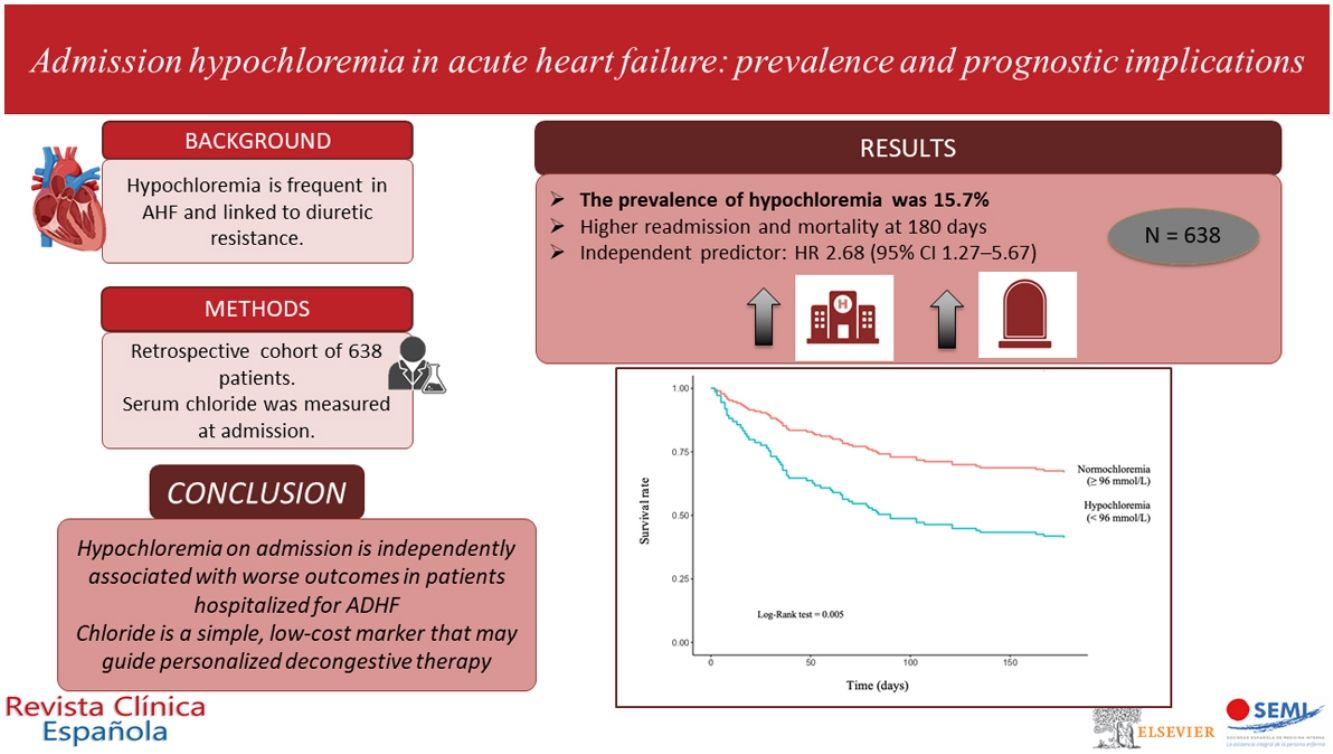
Hypochloremia was present in 15.7% of patients. This group had higher rates of chronic HF, greater outpatient loop diuretic use and doses, lower sodium and diastolic blood pressure, and higher bicarbonate levels. Independent predictors of hypochloremia included lower sodium levels, inferior vena cava enlargement, and lower creatinine. At 180 days, the primary endpoint occurred more frequently in the hypochloremic group. Admission hypochloremia independently predicted the composite outcome (HR 2.68; 95% CI 1.27–5.67; p = 0.010), along with higher outpatient loop diuretic doses and lower admission sodium.

Conclusion

Hypochloremia on admission is independently associated with worse outcomes in patients hospitalized for ADHF. Serum chloride is an accessible, low-cost marker that may help identify high-risk patients and provide additional insight into congestion status. Further prospective studies are needed to confirm its prognostic role and determine whether chloride-guided approaches can improve clinical outcomes.

Keywords:
Acute heart failure
Hypochloremia
Diuretic response
Cardio-renal syndrome
Diuretics
Resumen
Introducción

El cloro sérico ha surgido como biomarcador pronóstico en insuficiencia cardíaca (IC), al asociarse la hipocloremia con peores resultados y resistencia a diuréticos. El objetivo fue evaluar la prevalencia, los predictores y el significado pronóstico de la hipocloremia al ingreso en pacientes con insuficiencia cardíaca aguda descompensada (ICA).

Métodos

Estudio observacional retrospectivo en 638 pacientes ingresados por ICA entre 2016 y 2025. Se recogieron datos clínicos, analíticos y ecográficos en las primeras 48 horas. La hipocloremia se definió como cloro sérico <96 mmol/L al ingreso. El objetivo primario fue un compuesto de mortalidad por cualquier causa y/o reingresos por IC a 180 días. Se realizaron análisis de regresión de Cox para identificar predictores independientes.

Resultados

La hipocloremia estuvo presente en el 15,7% de los pacientes. Este grupo mostró mayor prevalencia de IC crónica, uso de diuréticos de asa, menor sodio sérico y presión arterial diastólica y bicarbonato más elevado. Los predictores independientes de hipocloremia fueron sodio y creatinina más bajos y dilatación de la vena cava inferior. A 180 días, el evento primario ocurrió más en el grupo hipoclorémico. La hipocloremia predijo de forma independiente el desenlace compuesto (HR 2,68; IC95% 1,27–5,67; p = 0,010), junto con dosis más altas de diuréticos de asa y sodio más bajo al ingreso.

Conclusión

La hipocloremia al ingreso se asoció de forma independiente con peores resultados en pacientes hospitalizados por ICA. El cloro sérico es un marcador accesible y de bajo coste que podría ayudar a identificar pacientes de alto riesgo y aportar información adicional sobre el estado de congestión. Se precisan estudios prospectivos para confirmar su valor pronóstico y determinar si los enfoques guiados por el cloro pueden mejorar los resultados clínicos.
Palabras clave:
Insuficiencia cardíaca aguda
Hipocloremia
Respuesta diurética
Síndrome cardiorrenal
Tratamiento diurético
Graphical abstract

Article

These are the options to access the full texts of the publication Revista Clínica Española (English Edition)
Member
Si es usted socio de FESEMI siga los siguientes pasos:

Diríjase desde aquí a la web de la >>>https://www.fesemi.org/publicaciones/revista-clinica/noticias<<< e inicie sesión mediante el formulario que se encuentra en la barra superior, pulsando sobre el candado.

Deslice el cursor hacia abajo hasta la sección "PUBLICACIONES" y pinche en "Revista Clínica Española":

>>>https://www.fesemi.org/publicaciones/revista-clinica/noticias<<<


Subscriber
Subscriber

If you already have your login data, please click here .

If you have forgotten your password you can you can recover it by clicking here and selecting the option “I have forgotten my password”
Subscribe
Subscribe to
Revista Clínica Española (English Edition)
Purchase
Purchase article

Purchasing article the PDF version will be downloaded

Purchase now
Contact
Phone for subscriptions and reporting of errors
From Monday to Friday from 9 a.m. to 6 p.m. (GMT + 1) except for the months of July and August which will be from 9 a.m. to 3 p.m.
Calls from Spain
932 415 960
Calls from outside Spain
+34 932 415 960
Email
References
[1]
E.M. Boorsma, J.M. Ter Maaten, K. Damman, et al.
Congestion in heart failure: a contemporary look at physiology, diagnosis and treatment.
Nat Rev Cardiol, 17 (2020), pp. 641-655
[2]
T.A. McDonagh, M. Metra, M. Adamo, et al.
2021 ESC Guidelines for the diagnosis and treatment of acute and chronic heart failure.
Eur Heart J, 42 (2021), pp. 3599-3726
[3]
R. Spevack, M. Al Shukairi, D. Jayaraman, J. Dankoff, L. Rudski, J. Lipes.
Serial lung and IVC ultrasound in the assessment of congestive heart failure.
Crit Ultrasound J, 9 (2017), pp. 7
[4]
A. Koratala, G. Romero-González, H. Soliman-Aboumarie, A. Kazory.
Unlocking the potential of VExUS in assessing venous congestion: the art of doing It right.
Cardiorenal Med, 14 (2024), pp. 350-374
[5]
J.L. Januzzi, R. van Kimmenade, J. Lainchbury, et al.
NT-proBNP testing for diagnosis and short-term prognosis in acute destabilized heart failure: an international pooled analysis of 1256 patients: the International collaborative of NT-proBNP study.
Eur Heart J, 27 (2006), pp. 330-337
[6]
J. Núñez, P. Llàcer, V. Bertomeu-González, et al.
Carbohydrate antigen-125-guided therapy in acute heart failure: CHANCE-HF: a randomized study.
JACC Heart Fail, 4 (2016), pp. 833-843
[7]
J. Rubio-Gracia, B.G. Demissei, J.M. Ter Maaten, et al.
Prevalence, predictors and clinical outcome of residual congestion in acute decompensated heart failure.
Int J Cardiol, 258 (2018), pp. 185-191
[8]
A.P. Ambros, P.S. Pang, S. Khan, et al.
Clinical course and predictive value of congestion during hospitalization in patients admitted for worsening signs and symptoms of heart failure with reduced ejection fraction: findings from the EVEREST trial.
Eur Heart J, 34 (2013), pp. 835-843
[9]
K. Damman, J.M. Ter Maaten, J.E. Coster, et al.
Clinical importance of urinary sodium excretion in acute heart failure.
Eur J Heart Fail, 22 (2020), pp. 1438-1447
[10]
J.M. Ter Maaten, I.E. Beldhuis, P. van der Meer, et al.
natriuresis-guided therapy in acute heart failure: rationale and design of the pragmatic urinary sodium-based treatment algorithm in acute heart failure (PUSH-AHF) trial.
Eur J Heart Fail, 24 (2022), pp. 385-392
[11]
J.M. Ter Maaten, I.E. Beldhuis, P. van der Meer, et al.
Natriuresis-guided diuretic therapy in acute heart failure: a pragmatic randomized trial.
Nat Med, 29 (2023), pp. 2625-2632
[12]
H. Kataoka.
Chloride in heart failure syndrome: its pathophysiologic role and therapeutic implication.
Cardiol Ther, 10 (2021), pp. 407-428
[13]
N. Arora.
Serum chloride and heart failure.
[14]
P. de Peralta García, M. Bolzoni, M. Yebra Yebra, et al.
Impact of hypochloremia as a prognostic factor in patients with heart failure, a retrospective cohort study.
Rev Clin Esp (Barc), 224 (2024), pp. 259-266
[15]
J.L. Grodin, J.L. Sun, K.J. Anstrom, et al.
Implications of serum chloride homeostasis in acute heart failure (from ROSE-AHF).
Am J Cardiol, 119 (2017), pp. 78-83
[16]
J. Núñez, G. Miñana, M. Villalonga, et al.
Serum chloride and the response to combining loop and thiazide diuretics for acute heart failure: the ALCALOTIC study.
Intern Emerg Med, 20 (2025), pp. 1399-1409
[17]
J. Van den Eynde, P. Martens, J. Dauw, et al.
Serum chloride and the response to acetazolamide in patients with acute heart failure and volume overload: a post hoc analysis from the ADVOR trial.
[18]
J. Núñez, G. Miñana, R. de la Espriella, et al.
Salt repletion and diuretic response: the role of serum chloride. A post-hoc analysis of the SALT-HF trial on furosemide and hypertonic saline solution administration in ambulatory patients with worsening heart failure.
Eur J Heart Fail, 27 (2025), pp. 960-971
[19]
D.B. Mount.
Thick ascending limb of the loop of henle.
Clin J Am Soc Nephrol, 9 (2014), pp. 1974-1986
[20]
J.S. Hanberg, V. Rao, J.M. Ter Maaten, et al.
Hypochloremia and diuretic resistance in heart failure: mechanistic insights.
Idiomas
Revista Clínica Española (English Edition)
Article options
Tools
Supplemental materials
