Article information
Article
These are the options to access the full texts of the publication Revista Clínica Española (English Edition)
Member
Si es usted socio de FESEMI siga los siguientes pasos:
Diríjase desde aquí a la web de la >>>https://www.fesemi.org/publicaciones/revista-clinica/noticias<<< e inicie sesión mediante el formulario que se encuentra en la barra superior, pulsando sobre el candado.
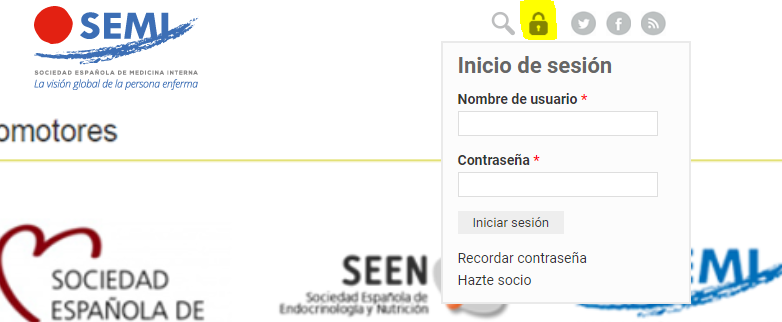
Deslice el cursor hacia abajo hasta la sección "PUBLICACIONES" y pinche en "Revista Clínica Española":

>>>https://www.fesemi.org/publicaciones/revista-clinica/noticias<<<
Purchase
References
[1]
L. Fisher, J.S. Gonzalez, W.H. Polonsky.
The confusing tale of depression and distress in patients with diabetes: a call for greater clarity and precision.
Diabet Med, 31 (2014), pp. 764-772
[2]
D. Young-Hyman, M. de Groot, F. Hill-Briggs, J.S. Gonzalez, K. Hood, M. Peyrot.
Psychosocial care for people with diabetes: a position statement of the American Diabetes Association.
Diabetes Care, 39 (2016), pp. 2126-2140
[3]
T.C. Skinner, L. Joensen, T. Parkin.
Twenty-five years of diabetes distress research.
Diabet Med, 37 (2020), pp. 393-400
[4]
Let’s talk about well-being for a better diabetes life. International Diabetes Federation. https://worlddiabetesday.org/. Accessed May 19, 2025.
[5]
American Diabetes Association.
Professional Practice Committee. Facilitating positive health behaviors and well-being to improve health outcomes: standards of care in diabetes—2025.
Diabetes Care, 48 (2025), pp. S86-S127
[6]
J. Lee, E.H. Lee, C.J. Kim, S.H. Moon.
Diabetes-related emotional distress instruments: a systematic review of measurement properties.
Int J Nurs Stud, 52 (2015), pp. 1868-1878
[7]
M. Beléndez, A. Hernández-Mijares, J. Marco, J.R. Domínguez, F.J. Pomares.
Validation of the Spanish version of the Problem Areas in Diabetes (PAID-SP) Scale.
Diabetes Res Clin Pract, 106 (2014), pp. e93-5
[8]
B.E. McGuire, T.G. Morrison, N. Hermanns, et al.
Short-form measures of Diabetes-related emotional distress: the Problem Areas in Diabetes Scale (PAID)-5 and PAID-1.
Diabetologia, 53 (2010), pp. 66-69
[9]
K. Cyranka, T. Klupa, M. Pilecki, et al.
Diabetes distress and diabetes burnout explored in various areas of life in patients with type 1 diabetes: effect of short-term psychological intervention.
Endocrine, 85 (2024), pp. 676-684
[10]
R.C. Kelly, R.I.G. Holt, L. Desborough, et al.
The psychosocial burdens of living with diabetes.
Diabet Med, 41 (2024),